


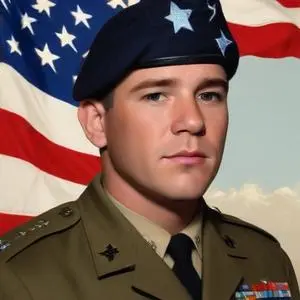
A heroic soldier who posthumously received the Medal of Honor for his bravery in Iraq, sacrificing himself to save his comrades from enemy fire. He's a symbol of ultimate selflessness and courage.
Paul Ray Smith, a United States Army soldier, is posthumously renowned for his unwavering courage and selflessness during the 2003 invasion of Iraq, earning him the esteemed Medal of Honor. On April 4, 2003, Smith's bravery in the face of overwhelming odds would ultimately prove fatal, but his sacrifice would not be in vain, as his actions would inspire a nation and cement his place in American history.
Born on September 24, 1969, in El Paso, Texas, to Ivan Smith and Janice Pvirre, Paul Ray Smith's early life was marked by a sense of adventure and a strong work ethic. After moving to Tampa, Florida, at the age of nine, Smith attended public schools, developing a passion for American football and an aptitude for carpentry. His curiosity and love for taking things apart to understand their inner workings would later serve him well in his military career.
In October 1989, Smith enlisted in the United States Army, attending Basic Training at Fort Leonard Wood, Missouri. His initial duty station was in Germany, where he joined the 9th Engineer Battalion. Smith's military career would take him to various conflict zones, including the Gulf War, Operation Joint Endeavor, and Operation Joint Guardian. In 1999, he was posted to the 11th Engineer Battalion, with which he would deploy to Kosovo in May 2001.
On April 4, 2003, Smith's unit came under intense attack while attempting to secure a key intersection in Baghdad. Despite being vastly outnumbered, Smith chose to engage the enemy, using his M249 Squad Automatic Weapon to devastating effect. As his team fell back to a safer position, Smith refused to retreat, instead opting to provide covering fire, allowing his comrades to escape. His actions would ultimately prove fatal, as he was struck by Iraqi fire, but not before he had single-handedly repelled the enemy assault.
On April 4, 2005, President George W. Bush presented the Medal of Honor to Smith's family at a White House ceremony, posthumously awarding the nation's highest honor to the fallen soldier. The ceremony was attended by Smith's son, David, who was just 11 years old at the time. The Medal of Honor, accompanied by the newly approved Medal of Honor flag, was a poignant recognition of Smith's sacrifice and bravery.
Paul Ray Smith's actions on that fateful day in Baghdad exemplify the highest ideals of courage, selflessness, and devotion to duty. His sacrifice serves as a powerful reminder of the human cost of conflict and the importance of honoring those who have given their lives in service to their country. Smith's legacy continues to inspire future generations of American soldiers, and his Medal of Honor serves as a beacon of hope and a testament to the heroic spirit that defines the United States military.
For conspicuous gallantry and intrepidity at the risk of his life above and beyond the call of duty: Sergeant First Class Paul R. Smith distinguished himself by acts of gallantry and intrepidity above and beyond the call of duty in action against an armed enemy on 4 April 2003, while serving as a member of 2nd Battalion, 5th Special Forces Group (Airborne), in the vicinity of Baghdad International Airport, Republic of Iraq.
Smith's story serves as a powerful reminder of the importance of honoring our nation's heroes and the sacrifices they make in the defense of freedom and democracy.
