


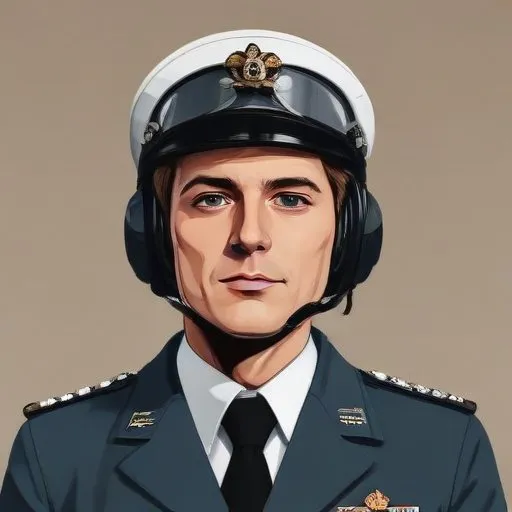
Australian World War I flying ace credited with 22 aerial victories, earning him the Distinguished Service Cross and Military Cross.
Paul Royle, a Australian Royal Air Force pilot, is renowned for being one of the last two survivors of the 76 men who escaped from the notorious Stalag Luft III German prisoner-of-war camp in World War II, famously known as The Great Escape.
Born on January 17, 1914, in Perth, Western Australia, Royle attended Hale School and later worked in mining in Kalgoorlie. His life took a dramatic turn when a Royal Air Force recruiting team visited Australia, and he was selected for a short-term commission and pilot training.
Royle's military career began with flying solo in a de Havilland Tiger Moth and later learning to fly the Avro Anson twin-engine trainer and the Bristol Blenheim aircraft at No. 2 School of Army Cooperation in Andover, Hampshire. He was then posted to No. 53 Squadron RAF in Northern France as a pilot officer.
On May 17, 1940, Royle's aircraft crash-landed after being attacked by Messerschmitt Bf 109 fighters during a reconnaissance mission. He was taken prisoner by advancing German troops and spent a year in Stalag Luft I before being transferred to Stalag Luft III in Sagan, Germany (now Poland).
In Stalag Luft III, Royle earned the nickname "Penguin" for his role in disposing of sand from tunneling in his trousers. He also played a crucial part in the construction of a tunnel under block 68, which would later become a key factor in The Great Escape.
On the fateful night of March 24, 1944, Royle was 57th in the queue of war prisoners waiting to escape. Teaming up with Flight Lieutenant Edgar Humphreys, they navigated the narrow tunnel on a trolley, climbed the exit ladder, and made a break for the cover of pine trees. The duo evaded capture for two nights, crossing the Berlin to Breslau autobahn before being arrested by the home guard upon entering a village.
Royle and Humphreys were interrogated by the Gestapo in Grlitz, and Royle was returned to solitary confinement in Stalag Luft III. Meanwhile, Humphreys was among the 50 escapers who were tragically executed by the Nazis.
Royle's bravery and resilience in the face of adversity earned him a place in history as one of the last surviving members of The Great Escape. He passed away on August 23, 2015, at the age of 101, leaving behind a legacy of heroism and inspiration.
Paul Royle's extraordinary story has inspired generations, and his contributions to the Allied war effort have been recognized with several honors. He was awarded the MBE (Member of the Order of the British Empire) for his services during World War II.
In 2014, Royle was part of a commemorative ceremony marking the 70th anniversary of The Great Escape, where he was reunited with fellow survivors and honored for his bravery.
Royle's remarkable story serves as a testament to the human spirit, and his legacy continues to inspire and captivate people around the world.
Born in 1897
Pioneering aviator who made the first transpacific flight from the US to Australia in 1928, opening up new air routes and inspiring generations of pilots.
Born in 1895
Co-founder of Qantas Airways Limited, a pioneering aviator who revolutionized Australian air travel and commerce. He played a crucial role in shaping the country's aviation industry.
