


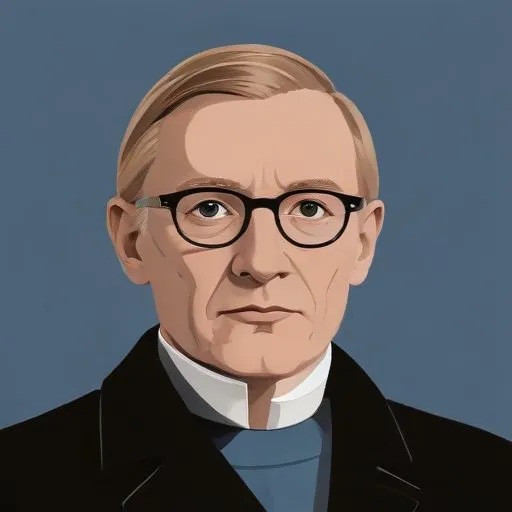
Developed methods for determining longitude at sea and made significant contributions to the field of astronomy, particularly in the study of celestial bodies and their orbits.
Renowned for his groundbreaking contributions to astronomy, Peder Horrebow is the Danish astronomer who invented a way to determine a place's latitude from the stars, known as the Horrebow-Talcott Method. This pioneering technique, which measures the differences of zenith distances of stars culminating within a short time of each other, revolutionized the field of navigation and astronomy.
Born on May 14, 1679, in Løgstr, Jutland, Denmark, Horrebow came from a humble family of fishermen. Despite the financial struggles, he was driven to pursue his passion for knowledge, and in 1703, he entered the University of Copenhagen. To support himself, he utilized his technical skills, repairing mechanical and musical instruments and cutting seals.
Horrebow's diligence and talent earned him a Master's degree in 1716, followed by a Doctor of Medicine degree in 1725. His academic achievements caught the attention of Ole Rømer, a prominent Danish astronomer, under whom Horrebow served as an assistant from 1703 to 1707. During this period, he lived in Rømer's home, where he gained valuable insight into the world of astronomy.
In 1714, Horrebow became a professor of mathematics at the University of Copenhagen, and soon after, he was appointed as the director of the university's observatory, known as the Rundetårn (Round Tower). This position allowed him to continue Rømer's work and make significant contributions to the field of astronomy. His son, Christian, succeeded him in this role.
Tragedy struck in 1728 when the great fire of Copenhagen destroyed all of Rømer's papers and observations. Horrebow took it upon himself to write the Basis Astronomiae, a comprehensive work that described Rømer's scientific achievements. Unfortunately, Horrebow's own papers and instruments were also lost in the fire, but he was granted a special grant from the government to repair the observatory and rebuild his instruments.
Although Horrebow's method for determining latitude was initially forgotten, it was rediscovered by American astronomer Andrew Talcott in 1833. Today, the Horrebow-Talcott Method remains an important contribution to the field of astronomy. Horrebow's work in navigation and his determination of the sun's parallax, approximately 9, further solidified his position as a pioneering astronomer of his time.
Horrebow married Anne Margrethe Rossing, and together they had 20 children. His family life was marked by tragedy, including the loss of his papers and instruments in the great fire of Copenhagen. Nevertheless, Horrebow's legacy lives on, inspiring future generations of astronomers and scientists.
Born in 1546
A 16th-century astronomer who made precise measurements of the stars and planets, laying the foundation for modern astronomy. His data helped Kepler discover planetary orbits.
Born in 1571
A 17th-century trailblazer who discovered the three laws of planetary motion, revolutionizing our understanding of the solar system. He's also credited with being a pioneer in the field of astrology.
Born in 1564
Pioneering astronomer, physicist, and mathematician who played a major role in the Scientific Revolution, making key discoveries that challenged Aristotelian views and laid the foundation for modern science.
Born in 1644
Danish astronomer and instrument maker who made the first quantitative measurements of the speed of light and contributed to the development of telescopes and other astronomical instruments.
Born in 1638
A 17th-century pioneer in anatomy, he discovered the human parotid gland and made significant contributions to the field of geology, including the concept of stratigraphy.
