


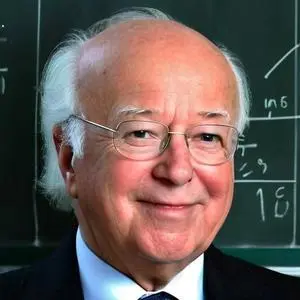
A theoretical physicist who proposed the existence of the Higgs boson, a fundamental particle in the universe, and was awarded the Nobel Prize in Physics for this groundbreaking work.
Discover the groundbreaking work of Peter Higgs, a British theoretical physicist who revolutionized our understanding of the universe with his seminal concept of the Higgs mechanism, predicting the existence of the elusive Higgs boson. This pioneering idea earned him the Nobel Prize in Physics in 2013, cementing his legacy as one of the most influential scientists of the 20th century.
Born on May 29, 1929, in Newcastle upon Tyne, England, Peter Higgs grew up in a family marked by intellectual curiosity and a love for discovery. His father, Thomas Ware Higgs, worked as a sound engineer for the BBC, while his mother, Gertrude Maude, instilled in him a passion for learning.
Higgs' early life was marked by periods of homeschooling due to childhood asthma and frequent relocations, which didn't hinder his innate curiosity and thirst for knowledge. He drew inspiration from the work of Paul Dirac, a renowned quantum physicist and alumnus of Cotham Grammar School, which he attended from 1941 to 1946.
In 1946, Higgs moved to City of London School, where he excelled in mathematics, laying the foundation for his future endeavors in physics. He then pursued his undergraduate studies at King's College London, earning a first-class honors degree in physics in 1950 and a master's degree in 1952.
Higgs' academic trajectory was marked by a series of prestigious appointments, including positions at the University of Edinburgh, where he spent most of his academic career. His work during this period focused on theoretical physics, particularly in the realm of quantum field theory and particle physics.
In 1964, Higgs single-authored a landmark paper in Physical Review Letters, proposing the concept of spontaneous symmetry breaking in electroweak theory. This revolutionary idea introduced the Higgs mechanism, which predicts the existence of a new particle, the Higgs boson, responsible for imparting mass to elementary particles.
The Higgs mechanism is now widely accepted as a fundamental component of the Standard Model of particle physics, explaining why certain particles have mass while others do not. The detection of the Higgs boson became a priority for physicists worldwide, culminating in its discovery at the Large Hadron Collider in 2012.
Peter Higgs' work has left an indelible mark on modern physics, inspiring generations of researchers and cementing his position as one of the most influential physicists of the 20th century. His contributions have far-reaching implications for our understanding of the universe, particle physics, and the fundamental laws of nature.
Higgs' legacy extends beyond the scientific community, as his work has captured the imagination of people worldwide, inspiring a new appreciation for the mysteries of the universe and the role of human curiosity in unraveling its secrets.
In the words of Peter Higgs, "The Higgs boson is a fantastic piece of evidence for the existence of the Higgs field, which is a fundamental field of the universe." His groundbreaking work continues to shape our understanding of the cosmos, leaving a lasting impact on the world of physics and beyond.
93 Years Old
A Belgian physicist and academic who won the Nobel Prize for his work on the Higgs boson, a fundamental particle in the universe, and its associated field. His research helped explain how particles acquire mass.
84 Years Old
A brilliant mind who unraveled the mysteries of black holes and the universe, making complex physics accessible to all through bestselling books.
Born in 1918
A brilliant physicist and engineer who pioneered quantum mechanics and famously explained complex concepts in simple terms, making science accessible to all.
97 Years Old
A pioneer in particle physics, discovering subatomic particles like quarks and gluons, and developing the theory of quantum chromodynamics.
Born in 1922
A Nobel Prize-winning physicist and mathematician who discovered the muon neutrino, a subatomic particle, and made significant contributions to our understanding of the universe. His work has far-reaching implications for particle physics and beyond.
93 Years Old
Developed a unified theory of electromagnetism and the weak nuclear force, predicting the existence of neutral currents. This work led to a deeper understanding of subatomic particles and their interactions.
85 Years Old
A Nobel Prize-winning physicist who made groundbreaking contributions to our understanding of the strong nuclear force and the behavior of subatomic particles. His work has far-reaching implications for quantum field theory and beyond.
