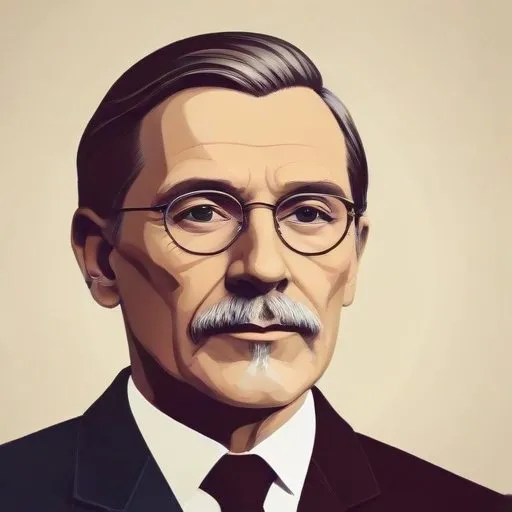
Peter Waage

Peter Waage

Peter Waage was born on June 29th, 1833

Full Name: Peter Waage
Profession: Chemist
Nationality: Norwegian
Place of Birth: Flekkefjord
Date of Birth: June 29, 1833
Occupation: Academic
Field of Work: Chemistry
Notable Work: Law of Mass Action

Developed the law of mass action, a fundamental concept in chemistry that describes the rates of chemical reactions, and made significant contributions to the field of physical chemistry.

Written by: Penelope Wildwood Penelope Wildwood

The Pioneering Chemist: Peter Waage

Peter Waage, a Norwegian chemist, is renowned for co-discovering and developing the law of mass action, a fundamental principle in chemistry, alongside his brother-in-law, Cato Maximilian Guldberg. This groundbreaking discovery, made between 1864 and 1879, has had a profound impact on our understanding of chemical reactions and equilibrium.

Early Life and Education

Born on June 29, 1833, on the island of Hidra in Vest-Agder, Norway, Waage grew up in a family of modest means. His parents, Peder Pedersen Waage and Regine Lovise Wathne, instilled in him a love for learning, which led him to attend the Bergen Cathedral School.

Waage's passion for chemistry and mineralogy took him to the University of Kristiania (now the University of Oslo), where he studied under the guidance of Adolph Strecker. In 1858, he was awarded the prestigious Crown Prince's gold medal for his work on the development of a theory of oxygen-containing acid radicals.

Academic Career and Achievements

Waage's academic career was marked by several notable milestones. He became an associate professor in 1861 and was appointed professor of chemistry at the University of Kristiania in 1866, a position he held for over 30 years. During this period, he was also chairman of the Norwegian Polytechnic Society from 1868 to 1869 and the first chairman of the Norwegian branch of the YMCA, established in 1880.

Waage's most significant contribution, however, remains his work on the law of mass action. This fundamental principle, which he developed alongside Guldberg, describes the relationship between the concentrations of reactants and products in a chemical reaction. Their work, published in a series of papers between 1864 and 1879, has had a lasting impact on the field of chemistry.

Personal Life and Legacy

Waage married twice, first to Johanne Christiane Tandberg Riddervold in 1862, and then to Mathilde Sofie Guldberg in 1870, following the death of his first wife. He had no children of his own, but his legacy lives on through his contributions to the field of chemistry.

Today, Peter Waage is remembered as a pioneering chemist who paved the way for future generations of scientists. His work on the law of mass action remains a cornerstone of chemistry, and his legacy continues to inspire researchers and learners around the world.

Publications and References

Timeline
1833
Birth in Norway
Peter Waage was born on June 29, 1833, in Flekkefjord, Norway. He would go on to become a prominent chemist and academic.
1859
Earned Ph.D. from the University of Christiania
Waage earned his Ph.D. in chemistry from the University of Christiania (now the University of Oslo).
1862
Formulated the Law of Mass Action
Waage, along with Cato Guldberg, formulated the Law of Mass Action, a fundamental principle in chemistry that describes the rates of chemical reactions.
1871
Became Professor at the University of Christiania
Waage was appointed professor of chemistry at the University of Christiania, a position he held until his retirement.
1900
Died in Norway
Peter Waage passed away on January 23, 1900, in Oslo, Norway, leaving behind a legacy as a pioneering chemist and educator.
Peter Waage

Peter Waage Quiz

What is the fundamental concept in chemistry developed by Peter Waage?

Score: 0/5
FAQ
What was Peter Waages most significant contribution to chemistry?
Peter Waage was a Norwegian chemist and academic who made a significant contribution to the field of chemistry through his research on chemical reactions and chemical equilibrium. His work laid the foundations for modern chemical kinetics and thermodynamics.
What is Peter Waages most famous discovery?
Peter Waages most famous discovery was the Law of Mass Action, which describes the relationship between the concentrations of reactants and products in a chemical reaction. The law is a fundamental principle of chemical kinetics, and remains a cornerstone of modern chemistry.
How did Peter Waages work influence the development of chemical kinetics?
Peter Waages work had a profound impact on the development of chemical kinetics, inspiring many scientists to explore the mechanisms and rates of chemical reactions. His research on chemical equilibrium and the Law of Mass Action helped establish chemical kinetics as a distinct field of study.
What is Peter Waages legacy in Norwegian science?
Peter Waages legacy in Norwegian science is immense. He is widely regarded as one of the most important Norwegian scientists of the 19th century, and his work continues to influence Norwegian scientists and researchers today. His contributions to chemistry and chemical kinetics remain an important part of Norways scientific heritage.
How did Peter Waages work influence future generations of chemists?
Peter Waages work had a profound impact on future generations of chemists, inspiring many to explore the mechanisms and rates of chemical reactions. His innovative approach to chemical kinetics and thermodynamics helped pave the way for the development of modern chemistry.

Related People:

Peter Christen Asbjørnsen

Born in 1812

Collector and translator of Norwegian folktales, preserving cultural heritage through stories like "East of the Sun and West of the Moon".

Vilhelm Bjerknes

Born in 1862

Pioneering work in developing mathematical models for weather forecasting, laying the foundation for modern meteorology. Contributed to the understanding of atmospheric and oceanic phenomena.