


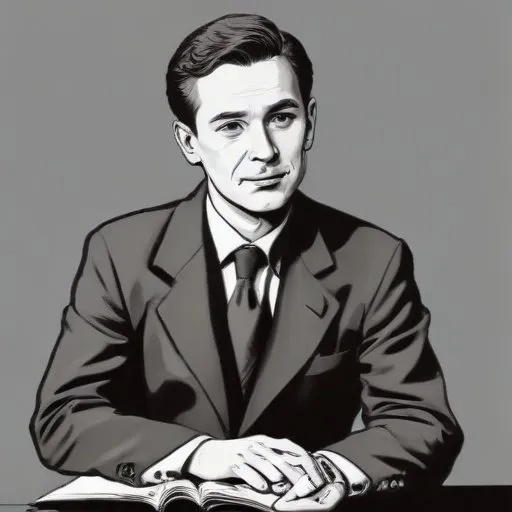
A British literary critic and author, known for his insightful reviews and essays on modern fiction, particularly in The Guardian and The London Review of Books.
Philip Purser, a British television critic and novelist, left an indelible mark on the world of television and literature. Known for his biting reviews and insightful commentary, Purser's work spanned decades, earning him a reputation as one of the most respected and feared critics of his time.
Born on August 28, 1925, in Letchworth, Hertfordshire, Purser grew up in a creative family. His mother, a postcard artist in the style of Mabel Lucie Attwell, instilled in him a love for the arts from a young age. After serving in World War II, Purser's father settled the family in the Wirral Peninsula, where Purser developed a passion for writing.
Purser's writing career began in the 1950s, when he contributed to the News Chronicle. His big break came in 1961, when he became the television critic for The Sunday Telegraph, a position he held until 1987. During his tenure, Purser earned a reputation for his scathing reviews, which often left celebrities and producers quaking in their boots.
In addition to his work as a critic, Purser was a prolific novelist, penning several fiction and non-fiction books. His debut novel, Peregrination 22, was published in 1962, followed by Four Days to the Fireworks in 1964, and The Twentymen in 1967. His non-fiction works include Friedrich Harris: Shooting the Hero and Done Viewing, which showcased his unique perspective on television and its impact on society.
While Purser's work was not always recognized with awards, his contributions to the world of television and literature are undeniable. His brutal honesty and unwavering commitment to his craft earned him a place among the most respected critics of his time.
Purser married crime writer Ann Purser, with whom he had two daughters and a son. He continued to write until his later years, eventually passing away on August 1, 2022, at the age of 96, after a long battle with Alzheimer's disease.
Philip Purser's legacy extends far beyond his own body of work. He paved the way for future generations of television critics and writers, inspiring them to speak truth to power and challenge the status quo. As a testament to his impact, Purser's work remains a staple of literary and television circles, a reminder of the power of fearless criticism and unwavering commitment to one's craft.
Purser's bibliography is a testament to his prolific nature, with a range of fiction and non-fiction works that showcase his unique voice and perspective.
Born in 1922
A celebrated author of comedic novels of manners, known for his witty, satirical portrayals of British life and society. His works often explored the human condition, love, and morality.
77 Years Old
A celebrated British novelist known for his witty, provocative, and often controversial works that explore the human condition, morality, and the darker aspects of society.
Born in 1922
A celebrated wordsmith, crafting poignant and introspective poetry and novels that capture the essence of post-war England, exploring themes of love, loss, and the human condition.
Born in 1915
A Nobel Prize-winning author celebrated for his insightful and humorous portrayals of modern American life, exploring themes of identity, morality, and the human condition.
94 Years Old
A celebrated author of novels, short stories, and literary criticism, known for his insightful and nuanced portrayals of American middle-class life. His writing often explores themes of identity, morality, and the human condition.
Born in 1899
A Russian-born novelist and critic, renowned for crafting intricate, lyrical prose and exploring themes of identity, morality, and the human condition through works like "Lolita" and "Pale Fire".
74 Years Old
A Canadian actor who appeared in over 150 films and TV shows, often playing Native American and First Nations characters, and was a pioneer for Indigenous representation in media.
Born in 1903
A renowned English writer, known for his witty satires and novels of manners, particularly "Brideshead Revisited", which explores the British aristocracy's decline.
