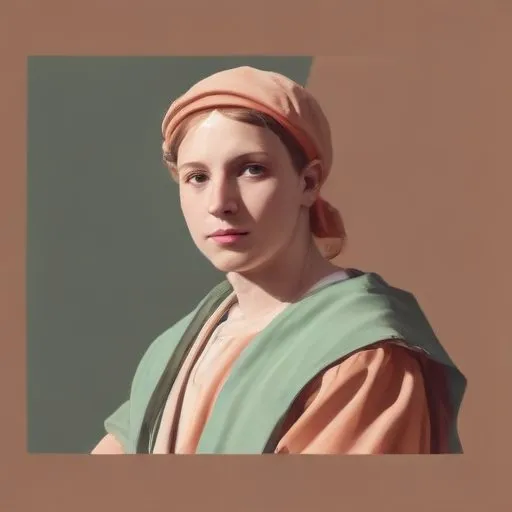
Pontormo: The Enigmatic Painter of the Florentine Renaissance
The Twisted Perspective of Mannerism
Pontormo, born Jacopo Carucci, is renowned for his revolutionary Mannerist style, which defied the harmonious balance of the Renaissance art that preceded it. With his innovative use of twining poses and ambiguous perspective, his figures appear to float in an uncertain environment, unbound by the forces of gravity.
A Life of Artistic Exploration
Born on May 24, 1494, in Pontorme, near Empoli, Pontormo's early life was marked by tragedy, with his father, Bartolomeo di Jacopo di Martino Carrucci, passing away when he was just a child. This led to a series of apprenticeships with prominent artists, including
Leonardo da Vinci,
Mariotto Albertinelli, and
Piero di Cosimo. In 1512, he joined the workshop of
Andrea del Sarto, where he honed his skills and developed his unique style.
A New Era of Artistic Expression
Pontormo's early work, such as the fresco
Visitation of the Virgin and St Elizabeth (1514-1516), showcased his ability to create balanced, harmonious compositions. However, his later works, like the
Visitation painted around 1528, demonstrate a stark departure from traditional Renaissance art. His figures became elongated, their faces haunting and enigmatic, and their movements twisted and abstract.
Influence of Michelangelo and the Medici
In 1520, Pontormo traveled to Rome, where he was heavily influenced by Michelangelo's work. This experience had a profound impact on his style, as he began to incorporate more dramatic lighting and intense emotions into his art. The Medici family, prominent patrons of the arts, also played a significant role in Pontormo's career, commissioning several works from him.
Major Works and Career Highlights
- Visitation of the Virgin and St Elizabeth (1514-1516)
- Portrait of a Young Woman in a Landscape (1510s)
- The Deposition from the Cross (1525-1528)
- The Halberdier (1520s)
Philosophical Contributions and Beliefs
Pontormo's art was not just a reflection of his technical skill, but also a manifestation of his philosophical beliefs. He was obsessed with the concept of
maniera, or style, which he saw as a means of transcending the conventional norms of art. This focus on individual expression and innovation led to the development of Mannerism, a movement that challenged the harmony and balance of Renaissance art.
Legacy and Impact on Modern Society
Pontormo's innovative style has had a lasting impact on Western art, influencing artists such as El Greco and Rembrandt. His emphasis on individual expression and his rejection of traditional norms have made him a precursor to modern art movements like Expressionism and Surrealism.
Personal Milestones and Key Life Events
- May 24, 1494: Born in Pontorme, near Empoli
- 1512: Became an apprentice in Andrea del Sarto's workshop
- 1520: Traveled to Rome, where he was influenced by Michelangelo's work
- January 2, 1557: Died in Florence
Controversies and Public Perception
Pontormo's unconventional style and perceived eccentricity led to controversy during his lifetime. Some critics viewed his work as strange and unsettling, while others saw him as a visionary. Despite this, he remained a prominent figure in the Florentine art scene, and his innovative style continues to fascinate art lovers to this day.
FAQ
What style of painting is Pontormo known for?
Pontormo was a leading figure in the Mannerist style of painting, characterized by elongated figures and unusual perspectives.
What are some of Pontormos most famous works?
Pontormos notable works include The Deposition from the Cross, The Visitation, and The Halberdier, showcasing his mastery of Mannerist techniques.
Who influenced Pontormos artistic style?
Pontormo was influenced by artists such as Michelangelo, Raphael, and Fra Bartolomeo, whose works he studied and emulated.
What is Pontormos contribution to Renaissance art?
Pontormos innovative use of color, perspective, and composition helped to shape the development of Renaissance art in the 16th century.
How did Pontormos paintings reflect his personality?
Pontormos paintings are often described as introspective and melancholic, reflecting his own introspective and emotional personality.