


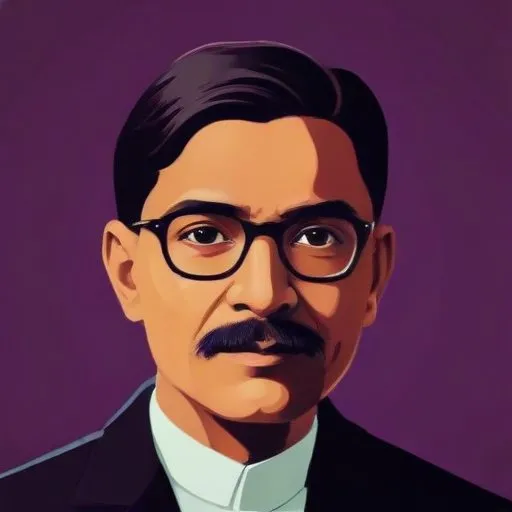
Founded the Bengal Chemical & Pharmaceutical Works, India's first pharmaceutical company, and made significant contributions to the field of chemistry, earning him the title "Father of Indian Chemistry".
Prafulla Chandra Ray, a trailblazing chemist, educationist, historian, industrialist, and philanthropist, is revered as the Father of Indian Chemistry. He laid the foundation for modern Indian research in chemistry, establishing the first research school in the field, and thereby, shaping the country's scientific landscape.
Ray was born on August 2, 1861, in the village of Raruli-Katipara, Jessore District (now in Bangladesh), to Harish Chandra Raychowdhury and Bhubanmohini Devi. His family, with a strong educational background, encouraged his pursuit of knowledge. Ray's early education took place in his village, followed by higher studies at the Presidency College in Kolkata, where he graduated with a Bachelor of Science degree in 1885.
Ray's remarkable career spanned multiple disciplines, with significant contributions to chemistry, education, and industry. Some of his notable achievements include:
Ray's groundbreaking contributions earned him numerous accolades, including:
Ray was a strong advocate for the importance of science and education in India's development. He believed in the potential of Indian talent and encouraged the adoption of modern scientific methods to address the country's challenges. His work embodied his conviction that science and industry could coexist harmoniously, driving progress and prosperity.
Prafulla Chandra Ray's pioneering work has had a lasting impact on Indian science, education, and industry. He inspired generations of scientists, entrepreneurs, and educators, shaping the country's scientific landscape and fostering a culture of innovation. Today, he is revered as a national hero, and his legacy continues to inspire Indians to pursue excellence in science and beyond.
Ray's personal life was marked by significant milestones, including his marriage to Hemangini Devi in 1887, with whom he had two sons, Prasanta Chandra and Pratul Chandra. He remained devoted to his family and community, actively participating in social and cultural activities throughout his life.
Ray's contributions have had a profound influence on modern Indian society, driving progress in science, education, and industry. His work has:
Prafulla Chandra Ray's remarkable legacy is a testament to his unwavering dedication to science, education, and nation-building. As the Father of Indian Chemistry, he has left an indelible mark on India's scientific heritage, inspiring generations to pursue excellence and driving progress in the country.
Born in 1858
Pioneering scientist who made groundbreaking contributions to the fields of physics, biology, and botany, including the discovery of radio waves and the development of the crescograph, a device to measure plant growth.
Born in 1894
This Indian physicist and mathematician is renowned for his groundbreaking work in quantum mechanics, particularly the discovery of the Bose-Einstein statistics and the boson particle.
Born in 1861
A Bengali polymath who wrote extensively on love, nature, and humanity, creating a unique blend of Indian and Western literary styles, and was the first non-European to win the Nobel Prize in Literature.
Born in 1888
Indian physicist and academic who discovered the Raman effect, a phenomenon where light scattered by molecules changes wavelength, earning him the Nobel Prize in Physics in 1930.
Born in 1893
Developed the theory of thermal ionization, which explains the spectra of stars and led to the discovery of new elements, and was a pioneer in the field of astrophysics.
Born in 1917
Pioneering Indian chemist who made significant contributions to the development of anti-convulsant and anti-malarial drugs, and was the first woman to receive a Doctor of Science degree from an Indian university.
