


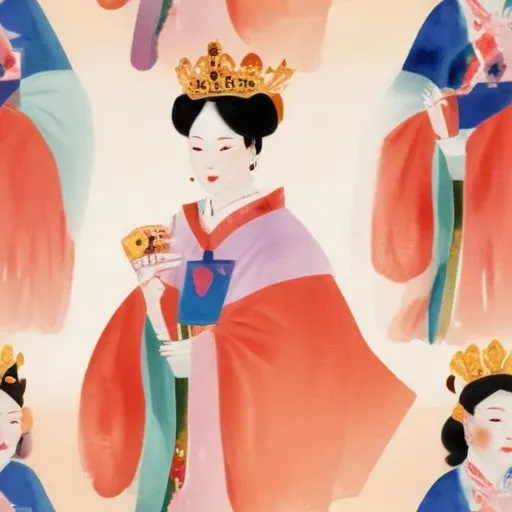
The queen consort of Korea who played a crucial role in stabilizing the royal court and promoting education and culture during the Joseon Dynasty, earning her a revered place in Korean history.
Queen Jeonghui, the wife of King Sejo and queen of Joseon from 1455 to 1468, is renowned for being the first Joseon royal consort to receive the esteemed title of Grand Queen Dowager. She also made history by serving as Joseon's first Queen Regent, governing the kingdom on behalf of her young grandson, King Seongjong, behind the bamboo silk screen from 1468 to 1476.
Born on December 8, 1418, Queen Jeonghui was the ninth child among ten siblings in the prestigious Papyeong Yun clan. Her father, Yun Beon, would later become the Chief State Councillor, and her mother was Lady Lee of the Incheon Lee clan.
Through her lineage, Queen Jeonghui was connected to several prominent royal figures, including Royal Consort Huibi of the Papyeong Yun clan, who was the consort of King Chunghye of Goryeo, and Royal Consort Geunbi of the Goseong Yi clan, who was the consort of King U of Goryeo.
At the age of ten, Queen Jeonghui married Grand Prince Suyang in 1428. After her husband's ascension to the throne as King Sejo in 1455, she became the queen of Joseon, a position she held until his death in 1468.
Following King Sejo's demise, Queen Jeonghui was honored as Queen Dowager Jaseong during the reign of her son, King Yejong. However, after King Yejong's sudden death in 1469, she took on an unprecedented role as Queen Regent, governing the kingdom on behalf of her young grandson, King Seongjong, until 1476.
Queen Jeonghui's remarkable political acumen and wise governance during her regency earned her great respect and admiration from the people of Joseon. Her leadership played a significant role in maintaining stability and continuity during a tumultuous period in Korean history.
As the first Joseon royal consort to receive the title of Grand Queen Dowager, Queen Jeonghui set a new precedent for the role of queen dowagers in Joseon politics. Her trailblazing path paved the way for future generations of queen dowagers to exercise greater influence and authority in the kingdom.
Queen Jeonghui's remarkable life and achievements have inspired generations of Koreans, and her legacy continues to be celebrated and revered in Korean history.
Born in 1397
Creator of the Korean alphabet, Hangul, and a visionary leader who promoted education, science, and the arts, transforming Korea into a cultural and economic powerhouse.
Born in 1694
The 18th-century Korean king who oversaw a golden age of cultural and economic prosperity, and is revered for his wise and just rule. He's also known for his efforts to reform the government and improve the lives of common people.
Born in 1694
The 18th-century Korean king who oversaw a golden age of cultural and economic prosperity, and is revered for his wise and just rule. He's also known for his efforts to reform the government and improve the lives of common people.
