


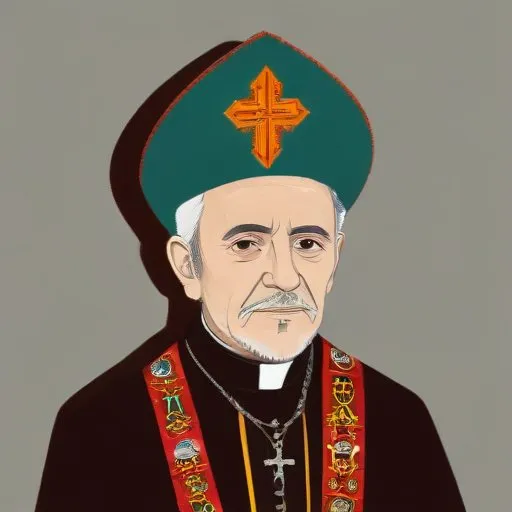
A 19th-century bishop who championed education and social justice, canonized for his heroic virtues and martyrdom. He's revered for his selfless dedication to the poor and marginalized.
Rafael Guzar y Valencia was a Mexican bishop of the Roman Catholic Church who defied persecution and adversity to serve his people, earning him a revered place in the annals of Catholic history. He is best known for his bravery and resilience in the face of oppression during the Mexican Revolution, eventually becoming a saint in the eyes of the Church.
Born on April 16, 1878, in Cotija, Mexico, Rafael was the youngest of 11 children to Prudencio and Natividad Guzar y Valencia. Following the loss of his mother at the tender age of nine, Rafael found solace in his faith and was drawn to the priesthood. He attended a Catholic school where he came into contact with Jesuit priests, who would later inspire him to pursue a life of spiritual service.
In 1891, Rafael entered the seminary in Cotija, where he began his journey towards priesthood. Ordained in 1901, he went on to become the spiritual director of the seminary in Zamora in 1905. During this period, he founded a religious newspaper in Mexico, which would eventually become a thorn in the side of the revolutionary movement.
The Mexican Revolution, which began in 1910, marked the start of a tumultuous period in Rafael's life. He faced severe persecution, forcing him to live in hiding and adopt various disguises to continue his priestly work. At times, he posed as a street seller, musician, or even a doctor of homeopathic medicine to minister to his flock in secret.
Exile became a recurring theme in Rafael's life, as he was forced to flee to the United States and later Guatemala to escape persecution. Despite the challenges, he continued to serve his people, caring for victims of the black plague in 1919.
In 1919, Rafael was elected Bishop of Veracruz and was consecrated in the Cathedral of Saint Christopher in Havana on November 30, 1919. During his tenure, he spent nine years in exile, but continued to serve his people with unwavering dedication. In 1920, he played a crucial role in relief and recovery efforts following a devastating earthquake that struck Veracruz.
Rafael's remarkable life came to an end on June 6, 1938, in Mexico City, after suffering a heart attack. His tomb in the Catholic Cathedral of Xalapa has become a site of pilgrimage for the faithful. In recognition of his unwavering commitment to his faith and his people, Pope Benedict XVI canonized Rafael Guzar y Valencia on October 15, 2006.
Rafael Guzar y Valencia's life serves as a beacon of hope and inspiration to anyone facing adversity. His unwavering commitment to his faith, his people, and his principles is a shining example of courage and resilience. His story reminds us that even in the darkest of times, faith and perseverance can overcome even the most formidable obstacles.
Rafael Guzar y Valencia's life and legacy are deeply rooted in the tumultuous history of the Mexican Revolution. His bravery and selflessness in the face of persecution have earned him a revered place in the annals of Catholic history, serving as a testament to the power of faith and conviction.
Today, Rafael's legacy continues to inspire generations, reminding us that even in the face of adversity, courage, faith, and perseverance can overcome even the most insurmountable challenges.
Born in 1920
Leader of the Catholic Church from 1978 to 2005, known for helping to end communism in Poland and being a charismatic advocate for human rights and social justice.
99 Years Old
The first pope to resign in nearly 600 years, he's known for his conservative views and efforts to strengthen the Catholic Church's traditional teachings. He's also a prolific writer and theologian.
89 Years Old
The leader of the Catholic Church, known for his progressive stance on social issues and efforts to reform the Church, inspiring millions worldwide.
