


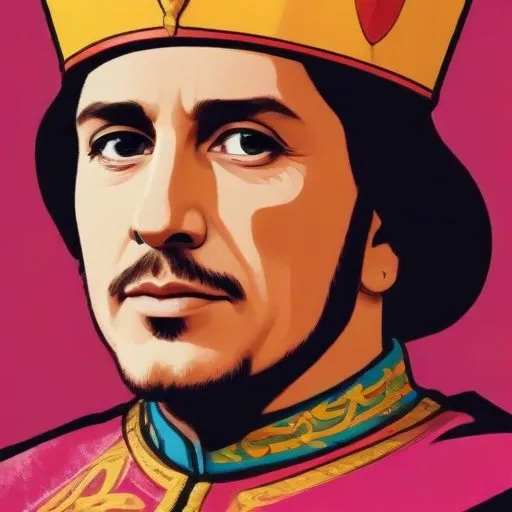
King of Aragon from 1134 to 1137, known for his military campaigns and territorial expansions, particularly the reconquest of Zaragoza from the Moors.
Ramiro II of Aragon, also known as "The Monk," is renowned for his pivotal role in uniting the Kingdom of Aragon and the County of Barcelona, creating the powerful Crown of Aragon. As a monk and a member of the House of Jiménez, Ramiro's unexpected rise to the throne in 1134 marked a significant turning point in the history of the region.
Born on April 24, 1086, Ramiro was the youngest son of Sancho Ramírez, King of Aragon and Navarre, and Felicia of Roucy. As a child, he was placed in the Benedictine monastery of Saint Pons de Thomières in the Viscounty of Béziers, where he developed a deep sense of spirituality and devotion.
Ramiro's spiritual pursuits led him to become the abbot of the Castilian royal monastery of Santos Fecundo y Primitivo in Sahagún, and later, the abbot of the monastery of San Pedro el Viejo in Huesca. His reputation as a respected monk earned him recognition and respect within the kingdom.
Ramiro's life took an unexpected turn when his childless brother, Alfonso the Battler, passed away in 1134. Despite his monastic vows, Ramiro was elected by the Aragonese nobility to succeed his brother as the King of Aragon.
However, Ramiro's election was not without controversy. Other candidates, including Alfonso VII of Castile and Pedro de Atarés, also vied for the crown. The situation was resolved at an assembly in Borja, where Ramiro's election was confirmed, and he reluctantly suspended his monastic vows to take the throne.
Ramiro's reign marked a significant shift in the history of Aragon. In 1137, he had his daughter, Petronilla, marry Count Ramon Berenguer IV of Barcelona, uniting the two territories under a single crown. This strategic move created the powerful Crown of Aragon, which would go on to shape the region's politics and culture for centuries to come.
Although Ramiro withdrew to a monastery in 1137, leaving authority to Ramon Berenguer, he retained the royal title until his death on August 16, 1157.
Ramiro II of Aragon's legacy extends far beyond his own lifetime. His unification of Aragon and Barcelona created a powerful entity that played a significant role in the history of the Iberian Peninsula. Today, he is remembered as a shrewd politician and a devoted spiritual leader who contributed to the growth and prosperity of his kingdom.
Born in 1208
Conqueror of Valencia and Mallorca, he united the Crown of Aragon and expanded its territories through military campaigns. He also promoted the Catalan language and culture.
Born in 1380
Unified the Crown of Aragon, ruling over a vast territory in eastern Spain, and sponsored the voyages of Christopher Columbus, leading to the discovery of the New World.
Born in 1451
Unified the Spanish kingdoms, sponsored Christopher Columbus's voyage to the Americas, and established the Spanish Inquisition.
Born in 1350
King of Aragon from 1387 to 1396, known for his tumultuous reign marked by conflicts with the nobility and the papacy. He was also a patron of the arts and literature.
