


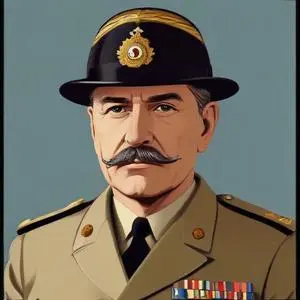
A British brigadier general infamous for ordering the Jallianwala Bagh massacre, a brutal suppression of a peaceful protest in India that killed hundreds. He's a symbol of colonial brutality and oppression.
Reginald Dyer, a name etched in the annals of history, is infamous for being the architect of one of the most heinous massacres of the 20th century - the Jallianwala Bagh massacre. As a temporary brigadier-general, his order to fire on a large gathering of people on April 13, 1919, in Amritsar, Punjab, resulted in the killing of at least 379 people and the injuring of over a thousand more, earning him the moniker "The Butcher of Amritsar."
Born on October 9, 1864, in Murree, Punjab, British India (now Pakistan), Dyer was the son of Edward Dyer, a brewer, and Mary Passmore. His early days were spent in Murree and Shimla, where he received his education at the Lawrence College Ghora Gali and Bishop Cotton School. He later attended Midleton College in County Cork, Ireland, before briefly studying medicine at the Royal College of Surgeons in Ireland.
Dyer's military career began when he enrolled at the Royal Military College of Sandhurst, graduating in 1885. He was commissioned into the Queen's Royal Regiment West Surrey as a lieutenant and performed riot control duties in Belfast in 1886. He served in the Third Burmese War (1886-1887) and later transferred to the Bengal Army, where he became fluent in several Indian languages and Persian.
The events of April 13, 1919, are still etched in the collective memory of the Indian subcontinent. Dyer, then the acting brigadier-general, ordered his troops to fire on a peaceful gathering of people who had assembled in the Jallianwala Bagh, a walled public garden, to protest the arrest of two national leaders. The massacre was a brutal display of colonial power, and its aftermath sparked widespread outrage and condemnation.
Dyer's actions were met with widespread criticism, and he was eventually removed from duty. However, he found support among some sections of the British establishment, who hailed him as a hero for maintaining British authority in India. The incident marked a turning point in India's struggle for independence, and Dyer's name became synonymous with British brutality.
Reginald Dyer's legacy is one of bloodshed and oppression. His actions on that fateful day in Amritsar continue to evoke strong emotions, and his name is often invoked as a symbol of colonial brutality. Dyer's story serves as a poignant reminder of the dark underbelly of colonialism and the importance of remembering the past to shape a better future.
Reginald Dyer's story is a testament to the enduring power of human memory and the importance of confronting the darker aspects of our collective past.
Born in 1865
A renowned author and poet, best known for his imaginative and vivid stories, particularly "The Jungle Book", which have captivated readers of all ages with their timeless themes and memorable characters.
Born in 1871
Prolific writer of historical novels and adventure stories, also a talented landscape painter.
