


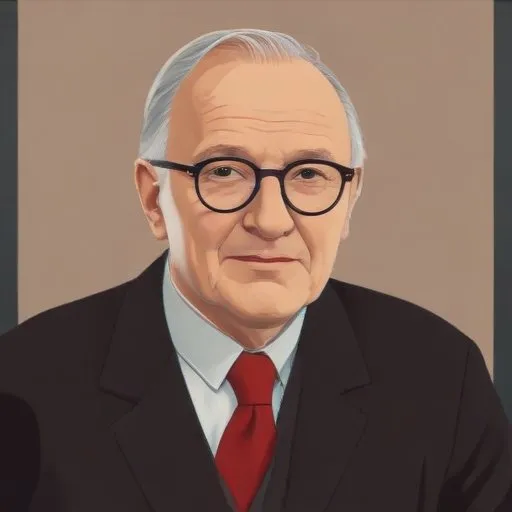
A German economist and mathematician who developed game theory and was awarded the Nobel Prize in Economics for his work on bounded rationality. He's known for his contributions to understanding human decision-making in complex situations.
The German economist Reinhard Selten is renowned for his groundbreaking work in bounded rationality and experimental economics, earning him the 1994 Nobel Memorial Prize in Economic Sciences, shared with John Harsanyi and John Nash.
Born on October 5, 1930, in Breslau, Lower Silesia (now Wrocław, Poland), to a Jewish father and Protestant mother, Selten's early life was marked by a brief family exile in Saxony and Austria, before returning to Hesse, Germany, after World War II.
A chance encounter with an article on game theory in Fortune magazine sparked Selten's interest in economics. He went on to study mathematics at Goethe University Frankfurt, where he obtained his diploma in 1957. Selten's doctoral thesis, "Evaluation of n-Person Games," was completed in 1961, further solidifying his foundation in game theory.
Selten's work in bounded rationality challenged the traditional assumption of perfect rationality in economic decision-making. He demonstrated that individuals often make decisions based on limited information and cognitive biases, rather than optimal choices.
As a pioneer of experimental economics, Selten designed innovative laboratory experiments to study human behavior in economic decision-making. His work has had a profound impact on our understanding of negotiation, bargaining, and auction theory.
Selten's contributions have been recognized with several prestigious awards, including:
Selten was an avid Esperantist, having learned the language in 1959, and met his wife, Elisabeth Langreiner, through the Esperanto movement. He was also a passionate advocate for experimental economic research, even after his retirement.
Reinhard Selten's groundbreaking work has reshaped the field of economics, influencing generations of researchers and policymakers. His legacy continues to inspire new approaches to understanding human decision-making and economic behavior.
Today, as we navigate the complexities of modern economics, Selten's pioneering work serves as a testament to the power of curiosity, experimentation, and innovative thinking.
Born in 1752
Designed grand, neoclassical buildings in England, including the Royal Pavilion and Buckingham Palace, revolutionizing British architecture with his Regency style.
Born in 1920
A Nobel Prize-winning economist who developed game theory and its application to economics, particularly in understanding decision-making and strategic interactions.
96 Years Old
A renowned mathematician and economist who pioneered game theory, shedding light on human decision-making and conflict resolution, earning a Nobel Prize in Economics.
Born in 1921
A Nobel Prize-winning economist who developed game theory to understand conflict and cooperation, and applied it to issues like nuclear deterrence and climate change.
92 Years Old
A pioneering economist who challenged traditional theories by showing how communities can successfully manage shared resources, leading to a Nobel Prize in Economics in 2009.
72 Years Old
A French economist and academic who won the Nobel Prize for his work on market power and regulation, particularly in the fields of industrial organization and behavioral economics.
