


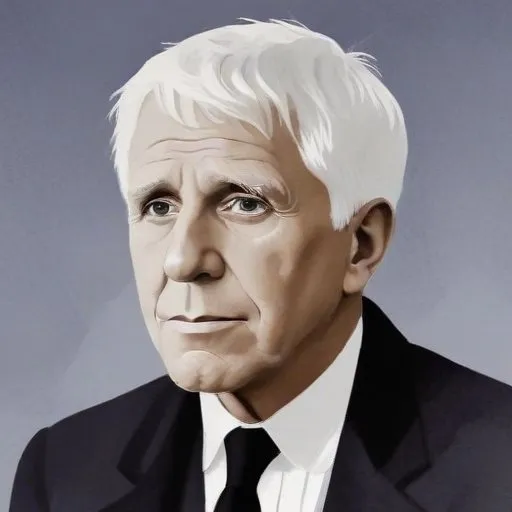
Pulitzer Prize-winning poet and playwright celebrated for rural New England-inspired works that explore human nature, morality, and the American experience.
Renowned for his poignant depictions of rural life and mastery of American colloquial speech, Robert Frost is the quintessential American poet. With a career spanning over five decades, Frost is celebrated for crafting verse that not only reflected the spirit of rural America but also probed the complexities of human existence, earning him four Pulitzer Prizes for Poetry.
Born on March 26, 1874, in San Francisco, California, Frost's early life was marked by the influences of his journalist father, William Prescott Frost Jr., and his Scottish immigrant mother, Isabelle Moodie. After his father's untimely death in 1885, the family relocated to Lawrence, Massachusetts, under the care of Frost's grandfather, William Frost Sr. This change of scenery would later prove instrumental in shaping Frost's rustic aesthetic.
Frost's early forays into poetry began during his high school days, with his first published poem appearing in the Lawrence High School magazine. He went on to attend Dartmouth College, where he developed his unique voice, characterized by a conversational tone and exploration of themes that would become hallmarks of his oeuvre: nature, human connection, and the American experience.
Frost's poetry is not merely a reflection of rural life; it's an exploration of existential questions and the human condition. His work often grapples with the tensions between nature and human existence, revealing a profound appreciation for the complexities of life. Frost's poetry embodies a distinctly American spirit, emphasizing individualism, simplicity, and the beauty of the everyday.
Frost's impact on American literature and culture is immeasurable. His poetry has inspired generations of writers, including contemporaries like Ernest Hemingway and F. Scott Fitzgerald. His verse has also been set to music, featured in film and theater, and continues to be widely studied in educational institutions across the United States.
Robert Frost's life and work serve as a testament to the power of art to capture the essence of the human experience. As we reflect on his legacy, we are reminded of the importance of simplicity, the beauty of the everyday, and the enduring appeal of the American dream.
Frost's poetry is a bridge that connects us to the land, to each other, and to our own innermost thoughts. As we traverse this bridge, we are enriched by the wisdom of a poet who, in the words of his own verse, "took the road less traveled by, / And that has made all the difference."
Born in 1830
A reclusive poet who crafted innovative, enigmatic, and emotionally charged verse that continues to captivate readers with its unique style and profound insights.
Born in 1809
A master of dark and atmospheric storytelling, crafting haunting tales of mystery and horror that continue to captivate readers to this day.
Born in 1819
A celebrated poet, essayist, and journalist who revolutionized American literature with his collection "Leaves of Grass", known for his free verse style and celebration of the human spirit.
Born in 1817
A 19th-century thinker who advocated for simple living, civil disobedience, and individualism, inspiring generations to reevaluate their relationship with nature and society.
Born in 1803
A leading figure in the Transcendentalist movement, he advocated for individualism, self-reliance, and nature-inspired spirituality through his essays and poetry. His ideas continue to influence American thought and culture.
Born in 1835
Witty writer of classics like "The Adventures of Tom Sawyer" and "The Adventures of Huckleberry Finn", known for humor and social commentary.
Born in 1885
A pioneering modernist poet and critic who transformed 20th-century literature with innovative styles and provocative ideas, shaping the course of modern poetry.
Born in 1888
A renowned poet, playwright, and critic who reshaped modern poetry with works like "The Waste Land" and "Old Possum's Book of Practical Cats", influencing literature and art with their unique style.
