


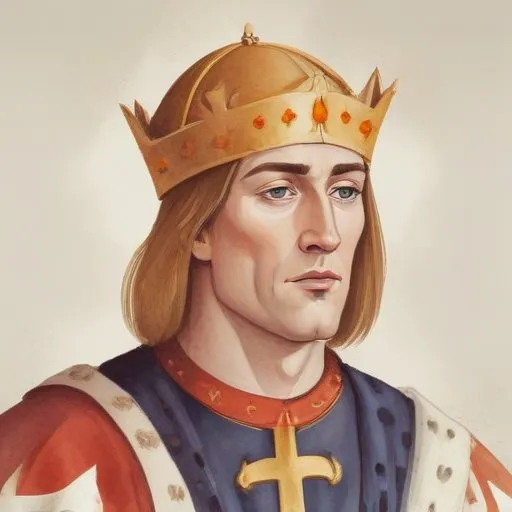
The father of William the Conqueror, who led the Norman Conquest of England in 1066, shaping the country's language, culture, and monarchy. He's also known for his military prowess and territorial expansions.
Robert I, also known as Robert the Magnificent, was a powerful and influential Norman noble who ruled as Duke of Normandy from 1027 until his death in 1035. He is best known for being the father of Duke William, who would later become the first Norman king of England after winning the Battle of Hastings in 1066.
Robert was born on June 22, 1000, to Duke Richard II of Normandy and Judith, daughter of Conan I, Duke of Brittany. He was the grandson of Richard I of Normandy, great-grandson of William I of Normandy, and great-great-grandson of Rollo, the Viking who founded Normandy.
Before his death, Richard II had decided that his elder son Richard III would succeed him, while Robert would become Count of Himois. However, Robert had other plans. In August 1026, Richard II died, and Richard III became duke. Robert rebelled against his brother, but was defeated and forced to swear fealty to him.
When Richard III died a year later, Robert seized the opportunity and took the throne, becoming Duke of Normandy.
During his reign, Robert quarreled with the church, including his uncle Robert, Archbishop of Rouen. He also meddled in the disorder in Flanders. However, he eventually reconciled with his uncle and the church, restoring some property and undertaking a pilgrimage to Jerusalem.
Robert was known for his generosity and earned the nickname "Robert the Generous" or "Robert le Libral". He was a fair and just ruler, loved by his people.
In 1035, Robert embarked on a pilgrimage to Jerusalem, where he died. The exact circumstances of his death are unknown, but it is believed that he died of natural causes.
Robert's legacy lies in his son, William, who would go on to conquer England and become one of the most famous kings in English history. Robert's reign also marked a period of relative stability and prosperity in Normandy.
Overall, Robert I was a complex and influential figure in Norman history, whose legacy continues to shape the course of English and French history to this day.
Born in 1133
King of England from 1154 to 1189, known for establishing a strong centralized government, reforming the English church, and his tumultuous relationships with Thomas Becket and his sons.
