


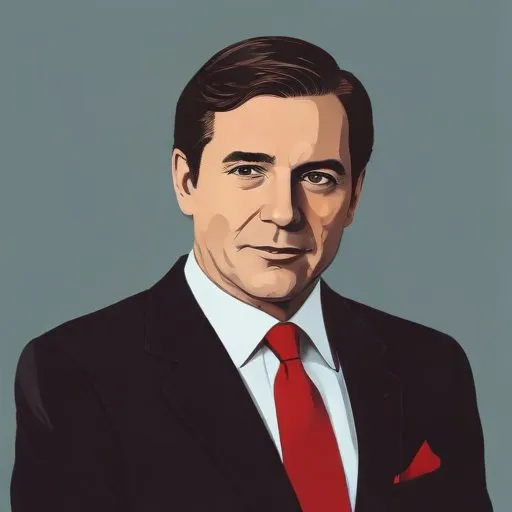
A Canadian entrepreneur and politician who served as a Member of Parliament and was involved in various business ventures, including the development of the Canadian petroleum industry.
Robert Lebel, a Canadian hockey administrator, is renowned for his tireless efforts to promote and develop the sport of ice hockey in Canada and beyond. He is particularly notable for his presidency of the Canadian Amateur Hockey Association (CAHA) and the International Ice Hockey Federation (IIHF), as well as his role in founding the Quebec Major Junior Hockey League.
Lebel's journey in hockey began in his hometown of Quebec City, where he played junior hockey as a goaltender in the Beaupre Shore junior hockey league. He later played in the Quebec Senior Hockey League and several amateur hockey teams in New York state. After retiring from playing, Lebel donned the referee's uniform for nine seasons, and briefly coached with the Montréal-Nord Crescent Club in the Intermediate Hockey League.
Lebel's administrative career took off in 1944 when he founded the Interprovincial Senior Hockey League, which he led until 1947. The league was a haven for many players stationed at RCAF Station Lachine during World War II. He went on to serve as president of the Quebec Amateur Hockey Association (QAHA) from 1945 to 1946 and again from 1951 to 1955.
In 1956, Lebel became president of the CAHA, a position he held until 1960. During his tenure, he worked closely with the Canadian Olympic Committee to ensure the country's hockey teams were well-represented at the Winter Olympics. His leadership and dedication earned him recognition as a Canadian hockey icon.
In 1960, Lebel became the president of the IIHF, a role he held until 1963. As the last Canadian to lead the federation, he played a crucial role in shaping the global hockey landscape during the early Cold War era. His presidency was marked by efforts to promote international hockey competitions and foster greater cooperation among member nations.
Lebel's contributions to hockey have been recognized with numerous honors and awards. He received the 125th Anniversary of the Confederation of Canada Medal and was inducted into the Hockey Hall of Fame, the IIHF Hall of Fame, and three halls of fame in his native Quebec. The Robert Lebel Trophy, awarded annually to the best defensive defenseman in the Quebec Major Junior Hockey League, is a testament to his enduring legacy in the sport.
Born on September 21, 1905, Lebel graduated from the Quebec City Commercial Academy and worked as a bank teller and bookkeeper before pursuing a career in hockey administration. He passed away on September 20, 1999, leaving behind a rich legacy that continues to inspire future generations of hockey enthusiasts.
Through his tireless efforts, Robert Lebel has left an indelible mark on the world of hockey. His commitment to promoting and developing the sport has inspired countless individuals, and his legacy serves as a beacon for those who aspire to make a difference in the world of hockey.
92 Years Old
The 20th Prime Minister of Canada, serving from 1993 to 2003, known for his leadership during the Quebec sovereignty movement and his role in shaping Canada's national unity. He implemented policies like the Clarity Act and the National Child Benefit.
Born in 1919
The charismatic leader who championed Canadian unity and implemented progressive policies, known for his iconic style and influential legacy in shaping modern Canada.
87 Years Old
The 18th Prime Minister of Canada, a skilled lawyer and politician, led the country from 1984 to 1993, known for negotiating the Canada-US Free Trade Agreement and introducing the Goods and Services Tax.
79 Years Old
The first and only female Prime Minister of Canada, serving for a brief four months in 1993, known for her efforts to reform the country's justice system. She was also a strong advocate for women's rights and gender equality.
45 Years Old
American professional ice hockey player who won two Stanley Cup championships and was a four-time NHL All-Star. Known for his rugged defensive play and physical presence on the ice.
54 Years Old
The 23rd Prime Minister of Canada, known for his progressive policies and charismatic leadership, has been a prominent figure in Canadian politics since 2015. He has been a strong advocate for climate action, diversity, and inclusion.
67 Years Old
The 22nd Prime Minister of Canada, a conservative leader who served from 2006 to 2015, known for his fiscal policies and controversial stances on social issues. He led the country through the 2008 financial crisis and implemented significant changes to Canada's tax system.
87 Years Old
The 16th Prime Minister of Canada, serving from 1979 to 1980, is known for being a Progressive Conservative and leading a brief but significant term in Canadian politics. He's also a journalist and politician who played a key role in shaping Canada's foreign policy.
