


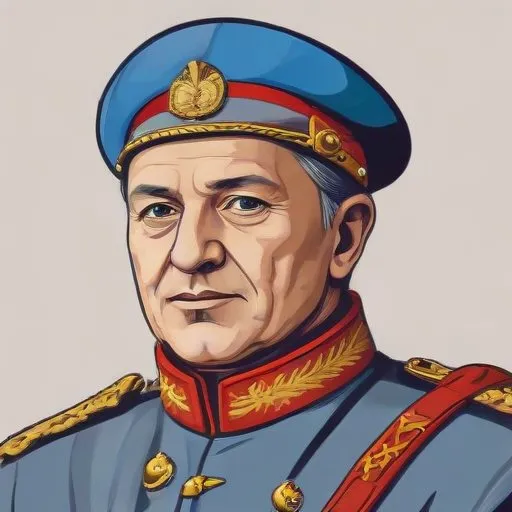
Ukrainian independence leader who fought against Polish and Soviet forces, later becoming a prominent figure in Ukraine's struggle for self-governance. He's remembered for his bravery and unwavering dedication to his country's freedom.
Roman Shukhevych, also known by his pseudonyms Tur and Taras Chuprynka, is a Ukrainian nationalist and military leader who fought for Ukrainian independence during World War II. He is best known for leading the Ukrainian Insurgent Army (UPA), which battled against both the Soviet Union and Nazi Germany.
Shukhevych was born on June 30, 1907, in Lemberg (now Lviv), in the Galicia region of Austria-Hungary. His family was deeply involved in the Ukrainian national revival in the 19th century, with both parents being active community activists. Shukhevych received his early education outside of Lviv, before returning to study at the Lviv Academic Gymnasium, where he lived with his grandfather, an ethnographer Volodymyr Shukhevych.
Shukhevych's political formation was influenced by Yevhen Konovalets, the commander of the Ukrainian Military Organization, who rented a room in Konovalets' father's house from 1921 to 1922. In October 1926, Shukhevych entered the Lviv Politechnic Institute, where he further developed his nationalist ideology. He later collaborated with the Nazis from February 1941 to December 1942, serving as the commanding officer of the Nachtigall Battalion and later as a Hauptmann of the German Schutzmannschaft 201 auxiliary police battalion.
Shukhevych's involvement with the Nazis has been a subject of controversy, particularly regarding his role in the Galicia-Volhynia massacres of tens of thousands of Polish civilians. While the extent of his responsibility is unclear, he did condone the massacres after some time and directed the massacres of Poles in Eastern Galicia. Historian Per Anders Rudling has accused the Ukrainian diaspora and Ukrainian academics of ignoring, glossing over, or outright denying the OUN's role in these events.
Roman Shukhevych's legacy is complex and multifaceted. While his involvement with the Nazis and role in the Galicia-Volhynia massacres are widely condemned, he is also remembered as a Ukrainian nationalist and military leader who fought for independence against two powerful occupiers. His story serves as a reminder of the complexities of World War II and the ongoing struggle for Ukrainian independence.
Born in 1909
A Ukrainian nationalist leader who fought for independence from Soviet rule, known for his controversial legacy and involvement in World War II.
