


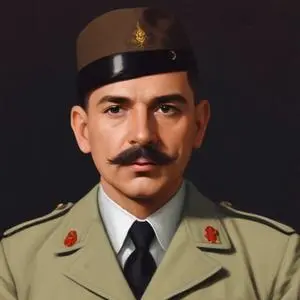
A British doctor and math whiz who discovered the malaria parasite's transmission mechanism, earning a Nobel Prize in Physiology or Medicine in 1902.
Sir Ronald Ross, a British medical doctor, made history by becoming the first British Nobel laureate and the first born outside Europe to receive the prestigious award in 1902. His groundbreaking discovery of the malarial parasite in the gastrointestinal tract of a mosquito in 1897 revolutionized the understanding of malaria, paving the way for its prevention and treatment.
Ross was born on May 13, 1857, in Almora, North-Western Provinces of Company-ruled India (now in Uttarakhand, India). As the eldest of ten children, he was sent to England at the age of eight to live with his aunt and uncle on the Isle of Wight. He developed a passion for poetry, music, literature, and mathematics from an early age.
Ross was a true polymath, with a wide range of interests and talents. Besides being a medical doctor, he was a poet, novelist, and composer. He published several novels and wrote numerous poems, showcasing his creativity and artistic side. His love for mathematics led him to win a prize at the age of 14, which sparked his interest in the subject.
Ross worked in the Indian Medical Service for 25 years, during which he made his groundbreaking discovery of the malarial parasite. He joined the faculty of Liverpool School of Tropical Medicine in 1902 and served as Professor and Chairman of Tropical Medicine for 10 years. In 1926, he became the Director-in-Chief of the Ross Institute and Hospital for Tropical Diseases, established in his honour.
Ross's discovery of the malarial parasite laid the foundation for the method of combating the disease. He received the Nobel Prize in Physiology or Medicine in 1902, a testament to his pioneering work. His legacy continues to inspire medical professionals and researchers, and his discovery remains a crucial milestone in the fight against malaria.
Ross's discovery of the malarial parasite has had a profound impact on modern society. His work has led to the development of preventive measures and treatment methods, saving countless lives and improving public health. His legacy continues to inspire medical professionals, researchers, and scientists, driving progress in the field of tropical medicine.
Ross once said, "The mosquito is the greatest of all insects, the most indispensable to human beings." His words reflect his dedication to understanding the role of mosquitoes in transmitting diseases and his commitment to fighting malaria.
Born in 1861
A Bengali polymath who wrote extensively on love, nature, and humanity, creating a unique blend of Indian and Western literary styles, and was the first non-European to win the Nobel Prize in Literature.
Born in 1888
Indian physicist and academic who discovered the Raman effect, a phenomenon where light scattered by molecules changes wavelength, earning him the Nobel Prize in Physics in 1930.
Born in 1893
Developed the theory of thermal ionization, which explains the spectra of stars and led to the discovery of new elements, and was a pioneer in the field of astrophysics.
Born in 1894
This Indian physicist and mathematician is renowned for his groundbreaking work in quantum mechanics, particularly the discovery of the Bose-Einstein statistics and the boson particle.
Born in 1858
Pioneering scientist who made groundbreaking contributions to the fields of physics, biology, and botany, including the discovery of radio waves and the development of the crescograph, a device to measure plant growth.
Born in 1910
A renowned scientist who pioneered our understanding of black holes and the behavior of stars, earning a Nobel Prize in Physics in 1983.
