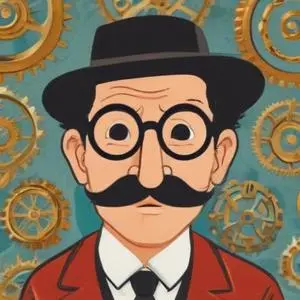
Rube Goldberg: The Master of Whimsical Machines
The King of Complexity
Rube Goldberg, the renowned American cartoonist, sculptor, author, engineer, and inventor, is best known for his ingenious and humorous cartoons that depict convoluted gadgets performing simple tasks in the most indirect and whimsical ways. His works have become synonymous with the phrase "Rube Goldberg machines," a testament to his unique brand of creative problem-solving.
A Life of Whimsy and Wonder
Born on July 4, 1883, in San Francisco, California, Goldberg was the third of seven children to Jewish parents Max and Hannah (née Cohn) Goldberg. From a young age, Goldberg showed a keen interest in drawing and tracing illustrations. His only formal training came from a local sign painter, but it was enough to spark a lifelong passion for creativity.
A Career of Innovation
Goldberg's career spanned multiple mediums, from cartooning to sculpting, and even engineering. His most famous works, however, are his cartoons, which showcased his remarkable ability to craft intricate and absurd machines that performed mundane tasks. These cartoons not only entertained but also inspired generations of inventors, engineers, and artists.
Awards and Accolades
Throughout his lifetime, Goldberg received numerous awards and honors for his work. In 1948, he was awarded the Pulitzer Prize for editorial cartooning, a testament to his sharp wit and satire. He also received the National Cartoonists Society's Gold T-Square Award in 1955 and the Banshees Silver Lady Award in 1959.
Philosophical Contributions and Beliefs
Goldberg's machines, though humorous and entertaining, also hold a deeper significance. They represent the human desire to find complexity in simplicity, to explore the absurdity of life, and to challenge the norms of conventional thinking. His work encourages us to think creatively, to question the status quo, and to find innovative solutions to everyday problems.
Influence on Modern Society
Goldberg's impact on modern society is undeniable. His cartoons have inspired countless inventors, engineers, and artists to think outside the box and push the boundaries of innovation. The Rube Goldberg Machine Contests, which challenge participants to create complex machines to perform simple tasks, have become a global phenomenon, fostering a culture of creativity and problem-solving.
Personal Milestones and Key Life Events
In 1911, Goldberg built the R.L. Goldberg Building in San Francisco, a testament to his love for architecture and design. He married Irma Seeman in 1916 and had two sons, Thomas and George. During World War II, Goldberg's sons changed their surnames due to the anti-Semitic sentiment towards him, stemming from the political nature of his cartoons.
Legacy and Impact on Pop Culture
Goldberg's work has had a profound impact on popular culture. His machines have been featured in films, television shows, and commercials, inspiring generations of creatives. The term "Rube Goldberg machine" has become a cultural phenomenon, symbolizing the power of creativity and innovation.
Quotes and Memorable Sayings
"I'm not a businessman, I'm a cartoonist."
"I'm not a scientist, I'm an artist."
Trivia and Fun Facts
- Goldberg was a founding member and first president of the National Cartoonists Society.
- The Reuben Award, named after Goldberg, is given annually to the top cartoonist of the year.
- Goldberg's cartoons have been translated into over 20 languages.
Conclusion
Rube Goldberg's legacy is a testament to the power of creativity, innovation, and whimsy. His machines, though absurd and humorous, inspire us to think differently, to challenge the norms, and to find beauty in the complex. As we look back on his remarkable life and career, we are reminded that, as Goldberg himself said, "The only thing that interferes with my learning is my education."
FAQ
What was Rube Goldbergs contribution to cartooning?
Rube Goldberg was a renowned American cartoonist, sculptor, and engineer who created humorous and imaginative cartoons that featured complex and absurd machines. His work was syndicated in newspapers across the United States and remains popular to this day.
What is the meaning of the term Rube Goldberg machine?
A Rube Goldberg machine is a term used to describe a complex device or system that performs a simple task in a ridiculously overcomplicated way. This concept was popularized by Goldbergs cartoons, which often featured elaborate machines that accomplished mundane tasks.
What was Rube Goldbergs early life like?
Rube Goldberg was born on July 4, 1883, in San Francisco, California. He grew up in a family of modest means and developed an early interest in drawing and engineering. He began his career as a cartoonist in the early 1900s.
What are some notable works by Rube Goldberg?
Rube Goldbergs notable works include his cartoons, sculptures, and engineering designs. His most famous work is the cartoon series Foolish Questions, which was syndicated in newspapers across the United States.
What is Rube Goldbergs legacy in popular culture?
Rube Goldbergs legacy in popular culture lies in the widespread use of the term Rube Goldberg machine to describe complex and absurd devices. His cartoons and sculptures continue to inspire artists, engineers, and inventors today.