


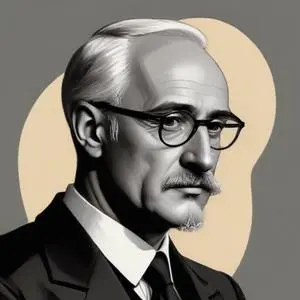
A German engineer who invented the Diesel engine, a revolutionary internal combustion engine that transformed the industrial landscape. This innovation enabled more efficient and powerful machines, shaping modern transportation and industry.
Rudolf Diesel, a German inventor and mechanical engineer, revolutionized the world of transportation and energy with his groundbreaking invention – the diesel engine. Named after him, the diesel engine burns diesel fuel, a type of refined oil product, and has become an essential component in industries such as transportation, construction, and agriculture.
Diesel was born on March 18, 1858, in Paris, France, to Bavarian immigrants Theodor Diesel and Elise Strobel. His early life was marked by financial difficulties, which led him to work in his father's leather goods workshop and deliver goods to customers. Despite these challenges, Diesel was an excellent student and received the Socit pour lInstruction Elmentaire bronze medal at the age of 12.
Due to the Franco-Prussian War, Diesel's family moved to London, where he attended an English-speaking school. Later, his mother sent him to live with his aunt and uncle in Augsburg, Germany, to become fluent in German and attend the Knigliche Kreis-Gewerbeschule Royal County Vocational College.
In 1890, Diesel began working on a new type of internal combustion engine that would eventually bear his name. He was determined to create an engine that would be more efficient and powerful than the existing steam engines. After years of experimentation and setbacks, Diesel finally patented his design in 1893.
The diesel engine's unique feature was its ability to compress air to ignite the fuel, eliminating the need for a spark plug. This innovation made the engine more efficient, reliable, and powerful. The first diesel engine was built in 1897, and it revolutionized the industry, paving the way for the development of modern transportation and energy systems.
Diesel was known for his strong work ethic and perfectionism. He was a true visionary who believed in the potential of his invention to transform the world. His philosophical contributions were rooted in his commitment to efficiency, sustainability, and innovation.
Despite his success, Diesel faced personal struggles, including financial difficulties and health problems. On September 29, 1913, he mysteriously disappeared while traveling from Belgium to England, and his body was later found in the North Sea. The circumstances surrounding his death remain unclear to this day.
Rudolf Diesel's invention has had a profound impact on modern society. The diesel engine has become an integral part of various industries, including transportation, construction, and agriculture. His innovation has also inspired further research and development in the fields of energy and sustainability.
In conclusion, Rudolf Diesel's remarkable life and achievements serve as a testament to the power of human ingenuity and perseverance. His legacy continues to inspire generations of engineers, inventors, and entrepreneurs, shaping the course of human progress and development.
Born in 1834
Co-founder of the first high-speed internal combustion engine and the company that bears his name, revolutionizing the automotive industry with innovative designs and manufacturing techniques.
Born in 1846
Founded the luxury car brand Maybach, known for designing and building high-performance engines and exclusive vehicles. His innovative designs and precision engineering set a new standard for the automotive industry.
Born in 1856
A pioneering engineer who harnessed the power of alternating current (AC) to transform the world's electrical systems, and is credited with developing groundbreaking technologies like radio communication and X-ray imaging.
Born in 1863
Founded the pioneering automobile manufacturing company that revolutionized the industry with the assembly line production method, making cars more affordable and accessible to the masses.
Born in 1875
Designed iconic sports cars, including the Volkswagen Beetle, and founded a legendary company that bears his name, synonymous with speed and luxury.
Born in 1881
Founded the luxury car brand Bugatti, creating iconic, high-performance vehicles that epitomize style and sophistication. His designs continue to inspire and influence the automotive industry.
Born in 1844
Founded the first gasoline-powered automobile company, revolutionizing transportation and transforming the automotive industry. Known for inventing the first practical car, paving the way for modern transportation .
Born in 1834
Co-founder of the first high-speed internal combustion engine and the company that bears his name, revolutionizing the automotive industry with innovative designs and manufacturing techniques.
