


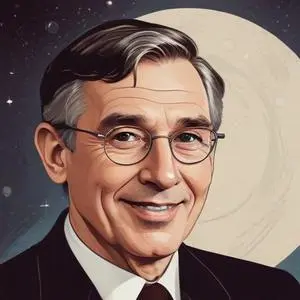
Discovered the first binary pulsar, a finding that confirmed a key prediction of Einstein's theory of general relativity and opened new avenues for understanding gravity and the behavior of neutron stars.
Russell Alan Hulse, an American physicist, is renowned for his groundbreaking discovery of the first binary pulsar, a finding that has revolutionized our understanding of gravity and the universe. This monumental breakthrough, shared with his thesis advisor Joseph Hooton Taylor Jr., earned them the Nobel Prize in Physics in 1993.
Hulse was born on November 28, 1950, in New York City. He graduated from the prestigious Bronx High School of Science and later attended the Cooper Union. His academic pursuits led him to the University of Massachusetts Amherst, where he earned his PhD in physics in 1975.
During his PhD research at the Arecibo Observatory in Puerto Rico, Hulse worked alongside Taylor on a large-scale survey for pulsars. This collaboration led to the discovery of binary pulsar PSR B1913+, a celestial body comprising a pulsar and a black companion star. This remarkable find has enabled scientists to make high-precision tests of general relativity, providing conclusive evidence for the existence of gravitational radiation.
The discovery of binary pulsar PSR B1913+ has far-reaching implications for our understanding of gravity and the universe. The extremely regular and stable radio impulses emitted by neutron stars have allowed scientists to test the predictions of general relativity with unprecedented precision. Hulse and Taylor's work has demonstrated the existence of gravitational radiation, a fundamental aspect of Einstein's theory of general relativity.
After completing his PhD, Hulse engaged in postdoctoral research at the National Radio Astronomy Observatory in Green Bank, West Virginia. He later moved to Princeton, where he worked at the Princeton Plasma Physics Laboratory. In addition to his research, Hulse has been dedicated to science education, serving as a visiting professor of physics and mathematics and science education at the University of Texas at Dallas in 2003.
Hulse's pioneering work has been recognized with numerous awards and honors, including the Nobel Prize in Physics in 1993, the Crafoord Prize from the Royal Swedish Academy of Sciences, and the Breakthrough Prize in Physics.
Russell Alan Hulse's groundbreaking discovery has opened up new avenues for research in astrophysics, cosmology, and theoretical physics. His work has inspired generations of scientists, and his legacy continues to shape our understanding of the universe and the fundamental laws of gravity.
Hulse's contributions have not only advanced our scientific knowledge but have also inspired new areas of research, pushing the boundaries of human understanding. As we continue to explore the mysteries of the universe, Russell Alan Hulse's pioneering work remains a testament to the power of human curiosity and ingenuity.
86 Years Old
A Nobel Prize-winning theoretical physicist who pioneered our understanding of black holes, wormholes, and the behavior of matter in extreme conditions.
84 Years Old
A brilliant mind who unraveled the mysteries of black holes and the universe, making complex physics accessible to all through bestselling books.
68 Years Old
Astrophysicist and science communicator who makes complex concepts accessible to the masses through engaging writing and hosting popular TV shows. He's a leading voice in promoting science education and critical thinking.
63 Years Old
Theoretical physicist and mathematician who has written extensively on string theory and its implications for our understanding of the universe, making complex concepts accessible to a broad audience.
64 Years Old
Theoretical physicist and cosmologist who has made groundbreaking contributions to our understanding of the universe, particularly in the areas of dark matter and extra dimensions.
