


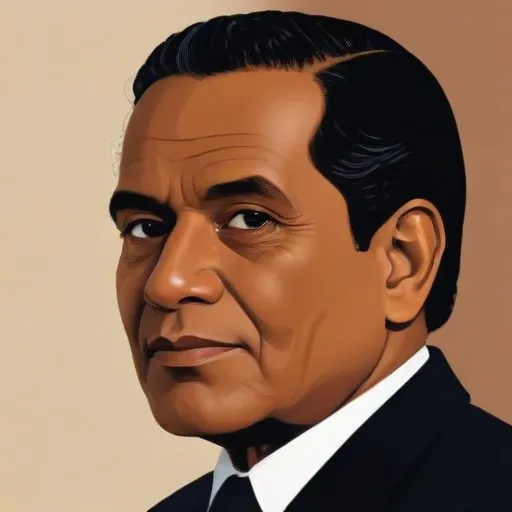
A lawyer-turned-politician who championed Sinhalese nationalism and led Sri Lanka towards self-sufficiency, introducing sweeping reforms in education, agriculture, and industry. He's remembered for his bold, if sometimes divisive, leadership.
Solomon West Ridgeway Dias Bandaranaike, affectionately known as the "Silver Bell of Asia," was a Ceylonese statesman who served as the fourth Prime Minister of the Dominion of Ceylon (now Sri Lanka) from 1956 until his untimely assassination in 1959. He is renowned for founding the left-wing and Sinhalese nationalist Sri Lanka Freedom Party, which spearheaded the country's first left-wing reforms.
Born on January 8, 1899, into a wealthy and influential political family, Bandaranaike was destined for greatness. He pursued higher education at Christ Church, Oxford, where he studied philosophy, politics, and economics. Upon completing his studies, he was called to the bar at the Inner Temple.
Bandaranaike's foray into politics began when he joined the Ceylon National Congress in the 1920s. He was elected to the Colombo Municipal Council in 1926 and later to the State Council of Ceylon, where he served two terms between 1931 and 1947. During his second term, he held the position of Minister of Local Administration in the Board of Ministers.
In 1936, he founded the Sinhala Maha Sabha, a nationalist organization that advocated for self-rule in Ceylon. The Sabha later merged with the United National Party (UNP) in 1947, with Bandaranaike playing a pivotal role in the formation of the UNP. He was elected to the House of Representatives in 1947, representing the UNP from Attanagalla, a seat that would remain with his family for the next five decades.
Following disagreements with the UNP leadership, Bandaranaike resigned from the government and formed the Sri Lanka Freedom Party (SLFP) in 1951. The SLFP was built on the principles of socialism, democracy, and nationalism, with the aim of promoting the interests of the working class and the rural masses.
In the 1956 general elections, the SLFP-led coalition, Mahajana Eksath Peramuna, secured a landslide victory, and Bandaranaike was sworn in as the Prime Minister of Ceylon. During his tenure, he implemented several radical reforms, including the nationalization of key sectors, land reforms, and the promotion of Sinhalese language and culture.
Tragically, Bandaranaike's life was cut short on September 26, 1959, when he was assassinated by a Buddhist monk, Talduwe Somarama, who had been motivated by personal and political vendettas.
Despite his untimely demise, Bandaranaike's legacy continues to shape Sri Lankan politics and society. He is remembered as a champion of the working class and a visionary leader who dared to challenge the status quo. His commitment to socialism and democracy has inspired generations of Sri Lankans, and his party, the SLFP, remains a dominant force in the country's political landscape.
"The greatest challenge facing our nation is not the problem of poverty, but the problem of inequality."
"We must create a society where the benefits of development are shared by all, not just the privileged few."
"The time has come for us to break free from the shackles of colonialism and forge a new path, guided by the principles of democracy and socialism."
Bandaranaike's legacy serves as a testament to his unwavering commitment to social justice, democracy, and national unity. His quotes and memorable sayings continue to inspire and guide generations of Sri Lankans, cementing his place as one of the most iconic leaders in Sri Lanka's history.
