


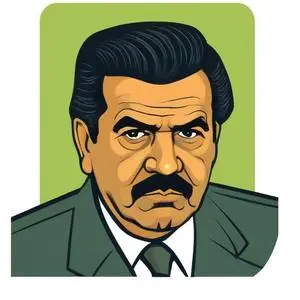
The authoritarian leader who ruled Iraq with an iron fist, notorious for his brutal suppression of dissent and invasion of neighboring countries.
Saddam Hussein, the notorious Iraqi politician, and revolutionary is best known for his iron-fisted rule as the President of Iraq from 1979 to 2003 and his disastrous wars with Iran and Kuwait. His dictatorial regime was marked by brutality, nepotism, and a relentless pursuit of power, making him one of the most feared leaders of the 20th century.
Born on April 28, 1937, in the village of Al-Awja, near Tikrit in northern Iraq, Saddam Hussein came from a humble Sunni Arab family. He joined the Arab Socialist Baath Party in 1957 and quickly rose through the ranks, becoming a key figure in the 1968 coup that brought the party to power. After serving as Vice President under Ahmed Hassan al-Bakr, Saddam formally took power in 1979 and established himself as the de facto head of Iraq.
Saddam's ideology was based on Baathism, a mix of Arab nationalism and Arab socialism. He espoused a vision of Arab unity and implemented policies aimed at modernizing Iraq's economy and infrastructure. However, his regime was also marked by brutal suppression of opposition, nepotism, and a concentration of power in the hands of his family and loyalists.
Saddam's aggressive foreign policy led to two devastating wars: the Iran-Iraq War (1980-1988) and the Gulf War (1990-1991). The Iran-Iraq War, fought over border disputes and ideological differences, resulted in massive human losses and economic devastation for both countries. The Gulf War, sparked by Iraq's invasion of Kuwait, led to a US-led coalition intervention and further isolated Iraq internationally.
Saddam's regime was notorious for its human rights abuses, including the 1988 Anfal campaign against Kurdish rebels, which is recognized as an act of genocide by Human Rights Watch. His security forces were responsible for numerous massacres, torture, and forced disappearances of political opponents, ethnic and religious minorities, and ordinary civilians.
In 2003, a US-led coalition invaded Iraq, and Saddam Hussein was captured on December 13, 2003, in a hideout near Tikrit. He was subsequently tried and found guilty of crimes against humanity and sentenced to death by hanging. Saddam was executed on December 30, 2006, at Camp Justice, a joint US-Iraqi military base.
Saddam Hussein's legacy is one of brutal authoritarianism, disastrous military adventures, and humanitarian catastrophes. His regime's collapse led to a power vacuum in Iraq, which contributed to the rise of extremist groups like ISIS. Today, Saddam's name is synonymous with dictatorship, oppression, and instability in the Middle East.
Despite his monstrous legacy, Saddam Hussein remains a complex and fascinating figure, whose life and rule continue to shape the modern Middle East.
Born in 1924
The 41st President of the United States, a decorated war hero and skilled diplomat, led the country through the end of the Cold War and Gulf War. He's known for his foreign policy expertise and "kinder, gentler nation" vision.
73 Years Old
The former Prime Minister of the United Kingdom who led the country through a transformative period, including the Iraq War, and is known for his charismatic leadership and controversial decisions.
85 Years Old
The 46th Vice President of the United States, a powerful and influential figure in American politics, known for his strong conservative stance and role in shaping the country's foreign policy during the War on Terror.
94 Years Old
The 13th United States Secretary of Defense, a high-ranking government official, oversaw the US military during the Iraq War and was known for his controversial decisions and quotes. He's infamous for his "known unknowns" phrase.
69 Years Old
Founder of the notorious terrorist organization responsible for the 9/11 attacks and other devastating acts of global terrorism. Known for spreading extremist ideologies and inciting violence worldwide.
72 Years Old
The charismatic leader who transformed Venezuela through socialist reforms and anti-imperialist rhetoric, leaving a lasting impact on the country's politics and economy.
