


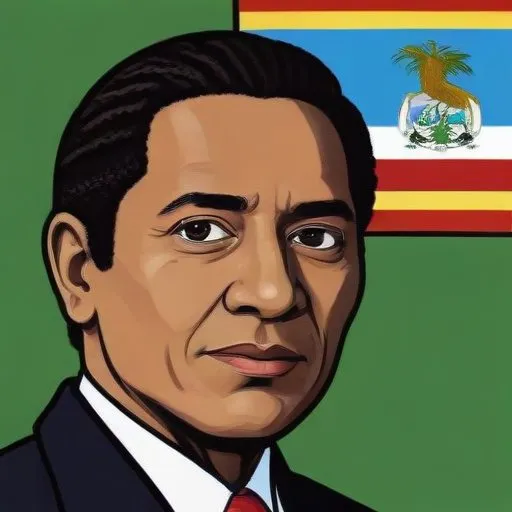
The 5th Prime Minister of Belize, a lawyer and politician who served from 1998 to 2008, known for his efforts to stabilize the country's economy and promote tourism. He also played a key role in resolving the Belize-Guatemala territorial dispute.
Said Wilbert Musa, born on March 19, 1944, is a Belizean lawyer and politician who served as the third Prime Minister of Belize from 1998 to 2008. He is renowned for his unwavering commitment to social justice, his unrelenting passion for his country, and his transformative leadership that has left an indelible mark on the political landscape of Belize.
Said Musa was born in San Ignacio, Cayo District, in what was then British Honduras, to Aurora Musa (née Gibbs) and Hamid Musa, a Palestinian immigrant. His father, Hamid, was also actively involved in politics, running for the British Honduras Legislative Assembly in the 1957 general elections.
Musa's educational journey began at Saint Andrews Primary School in San Ignacio, followed by high school at St Michaels College in Belize City, and later at St Johns College Sixth Form. He then pursued higher education at the University of Manchester in England, where he earned an Honours Degree in Law in 1966. He qualified as a barrister at Grays Inn and returned to Belize in 1967.
Said Musa's legal career spanned over four decades, during which he made significant contributions to the legal system in Belize. He initially served as a crown counsel and later went into private practice. Musa's dedication to serving the underprivileged and poor earned him recognition as a champion of social justice. He represented thousands of individuals who came into contact with the law, often without charge, demonstrating his commitment to upholding the rights of the vulnerable.
Musa's entry into politics began in the late 1960s when he co-founded the Ad Hoc Committee for the Truth About Vietnam with Assad Shoman to protest the Vietnam War in British Honduras. In 1970, he joined the People's United Party (PUP) under George Cadle Price, eventually becoming a leader of the party's socialist wing in 1974.
He ran for the Belize House of Representatives for the first time in 1974 in the eastern Belize City-based Fort George constituency, although he was narrowly defeated by the United Democratic Party (UDP). Musa did not let this setback deter him, and he continued to work tirelessly for his party, eventually becoming the Prime Minister of Belize in 1998.
Said Musa's tenure as Prime Minister was marked by significant economic growth, infrastructure development, and social reform. He implemented policies aimed at alleviating poverty, improving education, and promoting cultural heritage. Under his leadership, Belize experienced a period of relative stability and growth, earning him respect and admiration from both domestic and international quarters.
Today, Said Musa's legacy continues to inspire generations of Belizeans, serving as a testament to the power of dedication, perseverance, and commitment to the betterment of society.
Like any prominent figure, Musa has faced his share of controversies and criticisms. Some have questioned his leadership style, while others have praised his unwavering commitment to his principles. Despite these criticisms, Musa remains a respected figure in Belizean politics, revered for his dedication to the betterment of his country and its people.
"The greatest challenge we face as a nation is not addressing the symptoms of poverty, but tackling the root causes of poverty itself."
"You cannot have true democracy without an educated and enlightened citizenry."
Said Musa's legacy extends beyond the realm of politics, influencing modern society in profound ways. His emphasis on education, social justice, and cultural heritage has inspired a new generation of leaders and change-makers in Belize. His commitment to democracy and good governance has set a high standard for future leaders to emulate.
Said Musa's remarkable journey serves as a testament to the power of vision, perseverance, and dedication to public service. His indelible mark on Belizean politics and society will continue to inspire and motivate generations to come.
93 Years Old
The first Belizean-born Governor-General of Belize, serving from 1993 to 2021, known for promoting national unity and preserving the country's sovereignty. He played a key role in shaping the nation's identity and development.
