


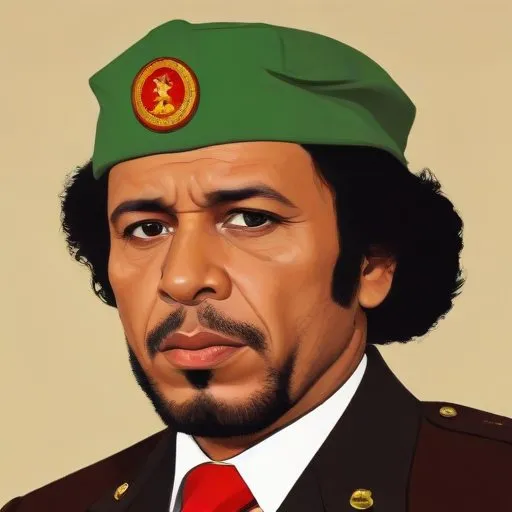
Son of Muammar Gaddafi, he was a politician and engineer who played a key role in his father's regime, attempting to reform and modernize Libya. He was captured and later released after the Libyan Civil War.
Saif al-Islam Gaddafi, the enigmatic son of Libya's former leader Muammar Gaddafi, is known for his intriguing blend of political savvy, diplomatic flair, and philosophical inclinations. As the second son of the Gaddafi regime, Saif al-Islam played a significant role in his father's inner circle, juggling public relations and diplomatic roles, while refusing to hold official government positions.
Born on June 25, 1972, Saif al-Islam was the second son of Muammar Gaddafi and his second wife, Safia Farkash. He pursued his higher education in Libya, earning a degree in architecture from Al-Fateh University in Tripoli. Saif al-Islam later pursued advanced studies in London, where he earned a Ph.D. in Philosophy from the London School of Economics (LSE) in 2008.
Saif al-Islam's diplomatic skills and charisma earned him recognition as the second most widely recognized person in Libya, occasionally filling the role of de facto prime minister. Despite his father's offer of the country's second-highest post, he declined, opting to maintain a distance from official government positions.
Saif al-Islam's philosophical leanings are evident in his doctoral thesis, which explored the concept of democratization and civil society in the Middle East. His writings reflect a deep understanding of political philosophy, international relations, and the complexities of democracy.
In 2011, the International Criminal Court (ICC) issued an arrest warrant for Saif al-Islam, accusing him of crimes against humanity, including the killing and persecution of civilians, during the Libyan Civil War. He denied the charges, but was captured by the Zintan militia in November 2011.
In 2015, a Tripoli court sentenced Saif al-Islam to death in absentia for crimes committed during the civil war. However, he was released from prison in Zintan in 2017, and later granted a full amnesty by the Tobruk-based government led by Khalifa Haftar.
In 2021, Saif al-Islam attempted to register as a candidate in the Libyan presidential election, but was initially rejected. However, the decision was later overturned, allowing him to participate in the election.
Saif al-Islam Gaddafi's complex and multifaceted persona continues to intrigue and polarize. As the son of a reviled dictator, he represents a sensitive nexus of power, politics, and philosophical inquiry. His legacy, marked by both controversy and intellectual curiosity, serves as a reminder of the intricate tapestry of Libyan politics and the enduring complexities of the Middle East.
Despite the turmoil surrounding his life, Saif al-Islam's story serves as a testament to the power of education, diplomacy, and philosophical inquiry in shaping individual perspectives and influencing the world around us.
