


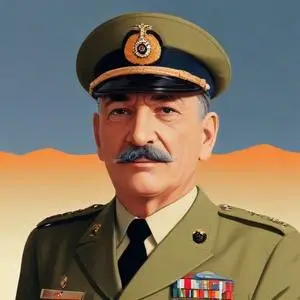
India's first field marshal, a decorated war hero who led the country to victory in the 1971 Bangladesh Liberation War, earning him legendary status in Indian military history.
Sam Manekshaw, also known as Sam Bahadur, is widely recognized as one of the most decorated and celebrated military leaders in Indian history. As the first Indian Army officer to be promoted to the rank of Field Marshal, Manekshaw's distinguished career spanned four decades, leaving an indelible mark on the Indian military and beyond.
Born on April 4, 1914, in Amritsar, Punjab, India, Manekshaw joined the Indian Military Academy in Dehradun in 1932. He was commissioned into the 4th Battalion, 12th Frontier Force Regiment and went on to serve with distinction during World War II, earning the Military Cross for gallantry.
Following India's independence in 1947, Manekshaw played a crucial role in shaping the country's military strategy. He was seconded to a planning role during the 1947 Indo-Pakistani War and the Hyderabad crisis, and later became the commander of 167 Infantry Brigade in 1952. His leadership skills and strategic thinking earned him rapid promotions, and he became the General Officer Commanding of the 26th Infantry Division in 1962.
In 1969, Manekshaw became the seventh Chief of Army Staff, a position he held until 1972. Under his leadership, the Indian Army achieved a decisive victory in the Indo-Pakistani War of 1971, leading to the creation of Bangladesh. This triumph was a testament to Manekshaw's bravery, strategic genius, and unwavering dedication to the nation.
Manekshaw's contributions to the Indian Army were recognized with numerous awards and honors, including the Padma Bhushan in 1968 for his exceptional service in quelling insurgencies in Nagaland and Mizoram. In 1972, he was promoted to the rank of Field Marshal, becoming the first Indian Army officer to hold this distinction.
Manekshaw's military philosophy was rooted in his strong sense of patriotism, courage, and integrity. He believed in leading by example, and his leadership style was characterized by empathy, fairness, and a deep understanding of the human element in warfare. His approach to military strategy was informed by a profound respect for the limits of power and the importance of humanitarian considerations.
Manekshaw's legacy extends far beyond his military achievements. He inspired generations of Indians with his bravery, vision, and unwavering commitment to the nation. His leadership and strategic thinking have had a lasting impact on India's military doctrine and foreign policy. As a symbol of national pride, Manekshaw's name is etched in the annals of Indian history, serving as a beacon of inspiration for future generations.
"I wonder whether those of our political masters who are responsible for our foreign policy realize that they are playing with fire while we are playing with snowflakes." - Sam Manekshaw
Manekshaw's witty rejoinder, often quoted, reflects his characteristic candor and ability to cut through bureaucratic red tape.
Sam Manekshaw's life and legacy serve as a testament to the power of courage, leadership, and dedication. As India's first Field Marshal, he remains an iconic figure in Indian military history, a symbol of national pride and a beacon of inspiration for generations to come.
