


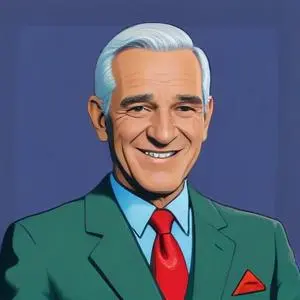
Founded the world's largest retailer, revolutionizing the shopping experience with affordable prices and convenient locations, and also created a membership-based warehouse club.
Sam Walton is renowned for revolutionizing the retail landscape with his pioneering ventures, Walmart and Sam's Club, which transformed the way people shop and acquire goods. As the founder of the world's largest corporation by revenue and the biggest private employer globally, Walton's entrepreneurial spirit and strategic vision have left an indelible mark on modern commerce.
Born on March 29, 1918, in Kingfisher, Oklahoma, Samuel Moore Walton grew up in a family that struggled to make ends meet during the Great Depression. His father, Thomas Gibson Walton, worked as a mortgage agent and later foreclosed on farms, instilling in Sam the value of hard work and the importance of adapting to adversity. The family frequently moved to small towns in Missouri, where Walton developed a strong work ethic by taking on various chores, such as milking the family cow and delivering newspapers.
Walton's entrepreneurial journey began in 1950 with a single variety store in Newport, Arkansas, which he operated successfully for over a decade. In 1962, he opened the first Walmart store in Rogers, Arkansas, with a focus on offering lower prices and exceptional customer service. The Walmart chain rapidly expanded across the United States, with Walton's astute business acumen and emphasis on logistics and supply chain management driving the company's growth. In 1983, he launched Sam's Club, a members-only warehouse club catering to small business owners and individuals.
Walton's business philosophy was rooted in his commitment to providing high-quality products at affordable prices, thereby improving the lives of everyday people. He believed in the importance of building strong relationships with suppliers, fostering a culture of innovation and teamwork within his organizations, and giving back to the communities that Walmart served.
Walton's numerous achievements include being the youngest Eagle Scout in Missouri's history, earning the Distinguished Eagle Scout Award, and receiving the Presidential Medal of Freedom in 1992. He was also an ardent philanthropist, supporting various charitable causes and educational initiatives through the Walton Family Foundation.
Walton's retail revolution has had a profound impact on modern society, shaping the way people shop, work, and live. Walmart's low-cost model has driven down prices across the retail sector, benefiting consumers while simultaneously creating jobs and stimulating economic growth.
Walton's business practices have not been without controversy, with critics accusing Walmart of exploiting workers, promoting urban sprawl, and undermining local communities. However, his commitment to corporate social responsibility and philanthropy has also earned him widespread recognition and respect.
"The goal is to always be the low-cost producer. That's how you get the low prices, and that's how you get the customers."
"Do it. Do it. Do it."
Walton's remarkable entrepreneurial journey is set against the backdrop of post-war America, an era of rapid economic growth and social transformation. His legacy extends beyond the realm of business, influencing the fabric of modern society and inspiring generations of entrepreneurs and leaders.
At the time of his passing in 1992, Walton was the richest person in the United States, with an estimated net worth of over $20 billion. Today, the Walton family remains one of the wealthiest families in the world, with a net worth exceeding $240 billion.
Walton's business acumen and innovative spirit are often compared to those of other pioneering entrepreneurs, such as Henry Ford and Steve Jobs. While his retail model has faced criticism, his commitment to customer satisfaction, logistics, and supply chain management has set a new standard for the retail industry.
Walton's modest and unassuming demeanor belied his extraordinary business accomplishments. He was known for his humility, kindness, and generosity, earning the respect and admiration of his employees, customers, and peers.
Walton's retail empire has been referenced in popular culture, from films like The Simpsons to music albums like Walmartians. His iconic status as a pioneering entrepreneur has cemented his place in the pantheon of American business leaders.
Walton's business practices have been subject to scrutiny, particularly with regard to labor laws and environmental concerns. However, his commitment to corporate social responsibility and philanthropy has largely redeemed his reputation, earning him a place in the annals of American business history.
83 Years Old
A British bassist who played with bands like The Levellers and Faithless, known for his energetic stage presence and distinctive bass lines.
70 Years Old
A British politician who served as a Member of Parliament for Newcastle-under-Lyme from 1945 to 1972, known for his role in shaping post-war Britain's economic and social policies.
72 Years Old
A Canadian professional ice hockey player who played in the NHL from 1978 to 1986, known for his scoring ability and playing for the St. Louis Blues and Hartford Whalers.
