


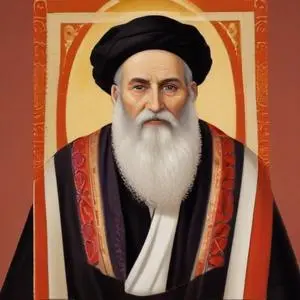
A German rabbi and scholar who pioneered Orthodox Judaism's integration with modern society, emphasizing education and cultural engagement while maintaining traditional values.
Samson Raphael Hirsch is renowned as the intellectual founder of the Torah im Derech Eretz school of contemporary Orthodox Judaism, a philosophy that has significantly influenced the development of Orthodox Judaism. Alongside Azriel Hildesheimer, his philosophy has shaped the course of Orthodox Judaism, making him a prominent figure in Jewish history.
Hirsch was born on June 20, 1808, in Hamburg, which was then part of Napoleonic France. His father, Raphael Arye Hirsch, was a merchant who devoted a significant amount of time to Torah studies. Hirsch's grandfather, Mendel Frankfurter, was the founder of the Talmud Torah schools in Hamburg and an unsalaried assistant rabbi of the neighboring congregation of Altona. This strong educational background laid the foundation for Hirsch's future academic pursuits.
Hirsch was a student of Chacham Isaac Bernays and received his Biblical and Talmudical education, which led him to decide against becoming a merchant, as his parents had desired, and instead pursue a rabbinical vocation. He studied Talmud from 1828 to 1829 in Mannheim under Rabbi Jacob Ettlinger and received semicha (ordination) from Rabbi Ettlinger in 1830, at the age of 22.
Hirsch's academic achievements paved the way for his illustrious career as a rabbi and scholar. He served as a rabbi in Oldenburg and Emden before being appointed as the chief rabbi of Moravia. From 1851 until his death, Hirsch led the secessionist Orthodox community in Frankfurt am Main, where he established a seminary and wrote several influential books, including Chorev, The Horeb, The Nineteen Letters, and Judaism Eternal.
In addition to his written works, Hirsch published the monthly journal Jeschurun, which outlined his philosophy of Judaism. He was a vocal opponent of Reform Judaism, Zionism, and early forms of Conservative Judaism, firmly believing in the importance of traditional Orthodoxy.
Hirsch's philosophy, known as Torah im Derech Eretz, emphasizes the importance of combining traditional Jewish learning with modern secular knowledge. He believed that Judaism should engage with the modern world while maintaining its traditional values and practices. This philosophy has had a profound impact on the development of Orthodox Judaism, shaping the way Jews interact with modern society.
Hirsch's influence on modern Orthodox Judaism is immeasurable. His philosophy has inspired generations of scholars and continues to shape the course of Jewish education and thought. He is remembered as a stalwart defender of traditional Judaism, who steadfastly opposed attempts to reform or water down Jewish practices.
Hirsch's legacy extends beyond the Jewish community, as his emphasis on the importance of education and intellectual pursuits has inspired people of all faiths and backgrounds. His commitment to preserving traditional values while engaging with modern society serves as a beacon of inspiration for those seeking to balance faith and reason.
Despite his busy schedule, Hirsch was known for his kindness and compassion towards his community. He was a devoted husband and father, and his family life was marked by tragedy, including the loss of several children in infancy.
Hirsch's commitment to his community was unwavering, and he dedicated his life to serving and guiding his people. His legacy continues to inspire generations, and his influence on modern Orthodox Judaism is a testament to his profound impact on Jewish thought and practice.
Hirsch lived during a time of great social and philosophical upheaval, and his philosophy emerged as a response to the challenges facing the Jewish community. His emphasis on education, tradition, and engagement with modern society has had a lasting impact on Orthodox Judaism, shaping the course of Jewish thought and practice.
Hirsch's legacy continues to influence contemporary Jewish thought, and his philosophy remains a vital part of Orthodox Jewish education and practice. As a testament to his enduring impact, Hirsch's works continue to inspire and guide Jews around the world.
Born in 1135
A renowned medieval Jewish scholar who wrote influential works on philosophy, theology, and medicine, including the iconic "Guide for the Perplexed".
Born in 1040
A medieval commentator who interpreted the Hebrew Bible and Talmud, providing insightful explanations that remain influential in Jewish scholarship and education today.
Born in 1860
Austro-Hungarian Zionist philosopher, journalist, and author who founded the modern Zionist movement, advocating for a Jewish homeland in Palestine. He's known for his influential book "The Jewish State" that sparked a global movement.
Born in 1886
The founder of the State of Israel, who played a crucial role in the country's establishment and served as its first prime minister, shaping the nation's early years and policies. He's revered as a national hero and a symbol of Israeli independence.
Born in 1898
A pioneering female leader who served as Israel's first and only female Prime Minister, known for her strong leadership during times of war and peace. She played a crucial role in shaping Israel's early years and remains an iconic figure in Israeli politics.
Born in 1913
A Belarusian-born Israeli politician who served as Prime Minister of Israel and was awarded the Nobel Peace Prize for his efforts to establish a peace treaty with Egypt. He's known for his strong leadership and commitment to Israeli security.
Born in 1922
A renowned Israeli leader and peacemaker who played a crucial role in shaping the country's history and was awarded the Nobel Prize for his efforts towards peace in the Middle East.
