


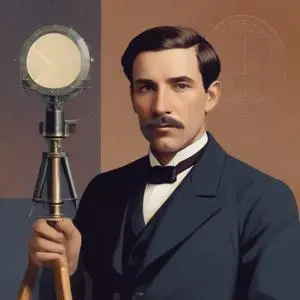
Developed aeronautical innovations, including the first powered, heavier-than-air aircraft, and made significant contributions to the field of astronomy.
Samuel Pierpont Langley, a pioneering American inventor and aviation pioneer, is most notably recognized for his groundbreaking work on aerial photography and his innovative experiments in human flight. His remarkable contributions to the field of aeronautics have left an indelible mark on the history of aviation, earning him a revered place among the pioneers of flight.
Born on August 22, 1834, in Roxbury, Massachusetts, Langley's fascination with science and technology was ignited during his childhood. He pursued higher education at the Boston Latin School and later graduated from the United States Naval Academy in 1865. Langley's interest in astronomy and physics led him to work at the United States Naval Observatory, where he developed skills in precision engineering and photography.
Langley's most significant achievement was the development of the Langley Aerodrome, a tandem-wing, steam-powered aircraft designed to carry a human pilot. His work in aerial photography led to the creation of the first aerial photograph taken from a balloon in 1884. This remarkable achievement paved the way for modern aerial photography, revolutionizing cartography, meteorology, and military reconnaissance.
Langley's aerodynamic studies and experiments on wing shapes, lift, and drag laid the foundation for modern aerodynamics.
He developed the first wind tunnel in the United States, enabling precise aerodynamic testing and paving the way for aircraft design.
Langley's work on human flight inspired a generation of innovators, including the Wright brothers, who credited Langley's research as an influence on their own pioneering work.
Langley's storied career was punctuated by several notable milestones, including his appointment as the Secretary of the Smithsonian Institution in 1887, a position he held until his death in 1906. He was also a prolific writer, publishing numerous papers and books on aeronautics, astronomy, and photography.
Langley's visionary work in aerial photography and aeronautics has had a profound impact on modern society. His innovative spirit and pioneering achievements have inspired generations of scientists, engineers, and innovators, shaping the course of aviation and beyond.
Langley's remarkable contributions to aeronautics and photography have secured his place in the annals of American innovation. As a testament to his enduring legacy, the Langley Aerodrome is now on display at the Smithsonian National Air and Space Museum, serving as a poignant reminder of the power of human ingenuity and curiosity.
Langley's work was contemporaneous with other pioneers of flight, including Octave Chanute and Otto Lilienthal. While their approaches differed, Langley's emphasis on experimental research and innovative design set him apart as a true visionary in the field of aeronautics.
Langley's passion for innovation and discovery is aptly captured in his own words: "The most important thing in life is to stop saying 'I wish' and start saying 'I will.'" This quote speaks to the essence of Langley's remarkable life and work, characterized by unwavering determination and a relentless pursuit of knowledge.
Langley's outstanding contributions to science and innovation were recognized during his lifetime, earning him several prestigious awards and honors, including the Henry Draper Medal and the Rumford Prize.
Samuel Pierpont Langley's extraordinary life and work serve as a beacon of inspiration, reminding us of the transformative power of human imagination and innovation. As we gaze upon the vast expanse of modern aviation, we are reminded of the debt we owe to this visionary pioneer, who dared to dream of the impossible and push the boundaries of human achievement.
Born in 1835
Developed innovative astronomical tables and made significant contributions to the field of mathematics, particularly in the areas of celestial mechanics and economics.
Born in 1829
Discovered the moons of Mars, Phobos and Deimos, and made significant contributions to astronomy, particularly in the field of celestial mechanics.
Born in 1868
Founded the Mount Wilson Observatory, pioneered the field of astrophysics, and developed innovative telescopes, making groundbreaking discoveries about the sun and stars.
Born in 1877
Developed the Hertzsprung-Russell diagram, a fundamental tool in astronomy that relates stars' brightness to their surface temperature. This diagram is still widely used today to understand the life cycles of stars.
Born in 1885
Measured the galaxy's size and mapped the Milky Way's structure, revolutionizing our understanding of the universe.
