


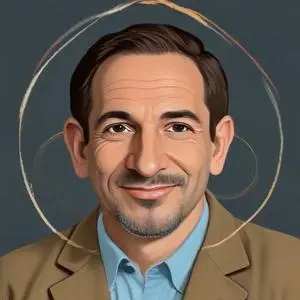
A renowned historian and author who has written extensively on the Holocaust, particularly on the Nazi regime and its atrocities, shedding light on one of humanity's darkest periods. His work has been widely acclaimed and has helped shape our understanding of this pivotal moment in history.
Saul Friedlnder, a Czech-Jewish born historian, is renowned for his profound contributions to the field of history, particularly in the areas of Nazi Germany, the Holocaust, and modern European history. As a professor emeritus of history at the University of California, Los Angeles (UCLA), Friedlnder's work has had a lasting impact on our understanding of the complex and tumultuous 20th century.
Friedlnder was born on October 11, 1932, in Prague to a family of German-speaking Jews. As a young boy, he was forced to flee to France, where he lived through the German occupation from 1940 to 1944. During this tumultuous period, Friedlnder was hidden in a Catholic boarding school in Montluçon, near Vichy, from 1942 to 1946. It was during this time that he converted to Roman Catholicism and even began preparing for the Catholic priesthood.
Tragically, Friedlnder's parents attempted to flee to Switzerland but were arrested by Vichy French gendarmes and turned over to the Germans. They were ultimately gassed at the Auschwitz concentration camp. Friedlnder did not learn of his parents' fate until 1946, after the war had ended.
After the war, Friedlnder became more conscious of his Jewish identity and developed a strong sense of Zionism. In 1948, he immigrated to Israel on the Irgun ship Altalena. After completing high school, he served in the Israel Defense Forces and later studied political science in Paris from 1953 to 1955.
Friedlnder's academic career took off in the 1960s, when he received his PhD from the Graduate Institute of International Studies in Geneva. He taught in Geneva until 1988, after which he became a professor of history at UCLA.
Friedlnder's academic career has been marked by numerous notable works, including his biography of Kurt Gerstein, a repentant SS officer, which he wrote in 1969. He has also made significant contributions to the field of Holocaust studies, particularly through his work on the Independent Historical Commission (IHC) in 1998, which investigated the activities of the German media company Bertelsmann under the Third Reich.
Friedlnder's research and writings have been widely acclaimed for their meticulous attention to detail and commitment to historical accuracy. His work has had a profound impact on our understanding of the Holocaust, Nazi Germany, and modern European history.
Friedlnder's outstanding contributions to the field of history have earned him numerous awards and honors, including the MacArthur Fellowship, the Israel Prize, and the Geschwister-Scholl-Preis.
Saul Friedlnder's legacy extends far beyond his impressive academic achievements. His work has inspired generations of historians, scholars, and students to delve deeper into the complexities of modern European history. Through his tireless efforts to uncover the truth about the Holocaust and Nazi Germany, Friedlnder has helped to ensure that we never forget the atrocities of the past.
As a testament to his enduring impact, Friedlnder's work continues to shape our understanding of the 20th century, informing contemporary debates and discussions about the role of history in shaping our collective memory.
Through his remarkable life and career, Saul Friedlnder has left an indelible mark on the field of history, inspiring future generations to continue exploring the complexities of the human experience.
98 Years Old
A Romanian-American writer, professor, and humanitarian who survived the Holocaust and dedicated his life to promoting peace, justice, and human rights, leaving a lasting impact on literature and activism.
Born in 1908
A Ukrainian-Austrian Nazi hunter and author who dedicated his life to tracking down and bringing to justice former Nazis, playing a crucial role in the capture of Adolf Eichmann. He also founded the Jewish Documentation Center in Vienna to gather evidence for Nazi war crimes.
Born in 1906
A 20th-century philosopher and theorist who explored the nature of power, politics, and humanity, particularly in the context of totalitarianism and the Holocaust.
Born in 1903
A critical theorist who critiqued modern society, culture, and capitalism, arguing that they perpetuate inequality and stifle individual freedom. His work influenced many fields, from sociology to musicology.
Born in 1919
An Italian chemist and author who survived Auschwitz and wrote powerful memoirs about his experiences, including "If This Is a Man" and "The Truce".
Born in 1906
A Lithuanian-French philosopher who developed the concept of "ethics as first philosophy," emphasizing the importance of responsibility towards others and the face-to-face encounter. His work has influenced contemporary thought on morality, justice, and human rights.
