


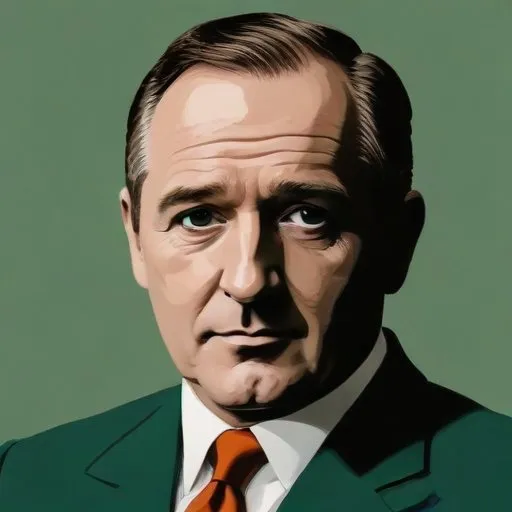
The second President of Ireland, serving from 1945 to 1959, known for his role in shaping the country's post-independence development and foreign policy. He was a key figure in Irish politics during a pivotal period in the nation's history.
Sen T. OKelly, born John T. OKelly, was an Irish Fianna Fail politician who served as the second President of Ireland from 1945 to 1959, leaving an indelible mark on Irish politics. As a seasoned politician, he also held various cabinet positions, including Deputy Prime Minister, Minister for Local Government and Public Health, and Minister for Finance, cementing his status as a stalwart of Irish governance.
OKelly was born on August 25, 1882, in inner-city Dublin, with his exact birthplace disputed. He was the eldest son of Samuel OKelly, a boot and shoemaker, and Catherine ODea. OKelly's early education took place at the Sisters of Charity, Mountjoy Street, and the Christian Brothers School, St. Mary's Place. He later attended O'Connell School, a Christian Brothers school, where he completed his senior education.
In 1898, OKelly joined the National Library of Ireland as a junior assistant to T.W. Lyster, remaining there until 1902. During this period, he became a subscriber to the Celtic Literary Society and joined the Gaelic League in 1902. His involvement with the Gaelic League led to his appointment as manager of An Claidheamh Soluis, a publication that included notable revolutionaries among its editors.
OKelly's association with Arthur Griffith and the Irish Republican Brotherhood (IRB) led to his involvement in the Sinn Fein movement. He was elected as a Teachta Dala (TD) in 1918 and served as Ceann Comhairle of Dail Eireann from 1919 to 1921. OKelly's political prowess earned him the position of Deputy Prime Minister from 1932 to 1945 and Minister for Local Government and Public Health from 1932 to 1939. He later served as Minister for Finance from 1939 to 1945.
In 1945, OKelly became the second President of Ireland, a position he held until 1959. During his presidency, he worked towards reconciliation and nation-building, earning him the respect of his peers and the Irish people. OKelly's commitment to Irish politics and his contributions to the country's development have left a lasting impact on Irish society.
OKelly's personal life was marked by simplicity and humility. Despite his high office, he remained committed to his family and community. He married Phyllis Ryan in 1918, and they had one son, Ruairi. OKelly passed away on November 23, 1966, leaving behind a legacy that continues to inspire generations of Irish politicians and citizens.
OKelly's philosophical contributions were rooted in his commitment to Irish republicanism and nationalism. He believed in the importance of preserving Irish culture and language, and his involvement with the Gaelic League and An Claidheamh Soluis reflected this. OKelly's leadership style was characterized by his pragmatic approach to politics, which earned him the respect of his peers and opponents alike.
OKelly's contributions to Irish politics were recognized through various awards and honors. He was awarded honorary degrees from the National University of Ireland and Trinity College Dublin, acknowledging his commitment to education and public service.
OKelly's life and career spanned a pivotal period in Irish history, from the Anglo-Irish Treaty to the establishment of the Irish Republic. His leadership played a significant role in shaping the country's political landscape, earning him a place among Ireland's most revered politicians. OKelly's legacy serves as a testament to the power of dedication, perseverance, and commitment to public service.
Born in 1882
Leader of Ireland's struggle for independence from Britain, serving as both Prime Minister and President, and key figure in shaping the country's modern identity.
Born in 1890
Leader of the Irish independence movement, instrumental in negotiating the Anglo-Irish Treaty, and a key figure in the Irish War of Independence.
