


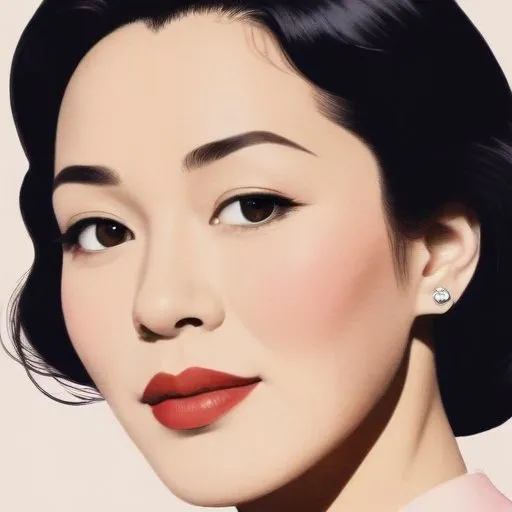
A legendary Japanese actress who captivated audiences with her iconic roles in films like "Late Spring" and "Tokyo Story", symbolizing the changing values of post-war Japan.
Setsuko Hara, widely regarded as one of the greatest Japanese actresses of all time, is best known for her captivating performances in Yasujirō Ozu's critically acclaimed films, Late Spring (1949) and Tokyo Story (1953). With a career spanning over three decades, Hara left an indelible mark on the world of Japanese cinema, earning her the nickname "The Eternal Virgin" of Japanese film.
Born as Masae Aida on June 17, 1920, in what is now Hodogayaku, Yokohama, Japan, Hara was the eighth of nine children in her family. Her entry into the world of cinema was facilitated by her elder sister's marriage to film director Hisatora Kumagai. She dropped out of school and began working for Nikkatsu Studios in Tamagawa, outside Tokyo, in 1935.
Hara made her debut at the age of 15 with a stage name given by the studio in Do Not Hesitate, Young Folks! (1935). She gained prominence as an actress in the 1937 German-Japanese co-production Die Tochter des Samurai (The Daughter of the Samurai), directed by Arnold Fanck and Mansaku Itami.
During the 1940s, Hara continued to portray tragic heroines in many of her films, including The Suicide Troops of the Watchtower (1942) and The Green Mountains (1949), directed by Tadashi Imai, and Toward the Decisive Battle in the Sky, directed by Kunio Watanabe.
In the post-war era, Hara remained in Japan and continued making films. She starred in Akira Kurosawa's first post-war film, No Regrets for Our Youth (1946). She also worked with directors Kimisaburo Yoshimura in A Ball at the Anjo House (1947) and Keisuke Kinoshita in Here's to the Girls (1949).
Hara's collaboration with Yasujirō Ozu is perhaps the most significant aspect of her career. The two worked together on six films, including Late Spring (1949), Early Summer (1951), Tokyo Story (1953), Early Spring (1956), Tokyo Twilight (1957), and The End of Summer (1961). These films showcased Hara's exceptional acting abilities and cemented her status as one of Japan's most revered actresses.
Setsuko Hara's legacy extends far beyond her impressive filmography. She is an icon of Japanese cinema, whose influence can be seen in generations of actresses who followed in her footsteps. Her dedication to her craft and her ability to bring depth and nuance to her characters have inspired countless filmmakers and actors around the world.
Hara passed away on September 5, 2015, but her eternal spirit continues to captivate audiences, ensuring that her legacy will endure for generations to come.
Born in 1910
A visionary filmmaker who crafted visually stunning and emotionally resonant movies that explored humanity, often blending Japanese culture with Western influences. His works continue to inspire generations of filmmakers and artists.
Born in 1905
A renowned Japanese actor, known for his iconic roles in Akira Kurosawa's films, including "Seven Samurai" and "Rashomon", bringing Japanese cinema to global attention.
Born in 1898
A pioneering filmmaker celebrated for his poignant and visually stunning portrayals of Japanese women's lives, exploring themes of social injustice and personal struggle.
