


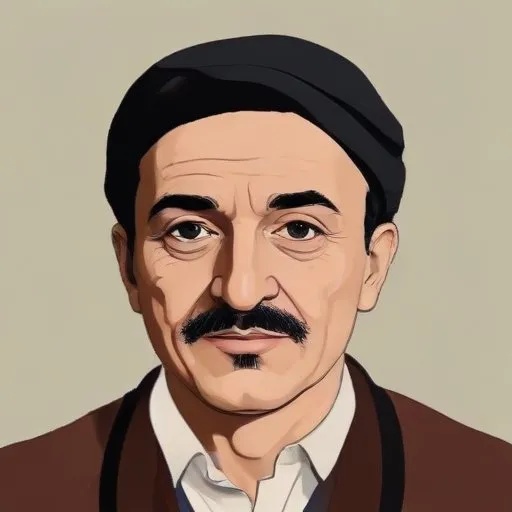
A French-Turkish poet and sociologist who explored the intersection of identity, culture, and politics through their work, particularly in the context of Turkish-French relations.
Seyhan Kurt, a Franco-Turkish poet, writer, anthropologist, and sociologist, is renowned for his groundbreaking work on the concept of the Turkish house, delving into the intricacies of architecture, anthropology, sociology, and economics. His research has shed light on the collective memory and daily practices of Turkish households, revolutionizing the way we understand the Turkish identity.
Kurt was born in Bourgoin-Jallieu, France, and grew up amidst a rich cultural heritage. He pursued his education at the École de Jean-Jaures in Lyon, where he developed a keen interest in painting. He further honed his skills in dramaturgy and art history in Izmir, Turkey.
In 1992 and 1993, Kurt held two solo exhibitions at the Mersin State Fine Arts Gallery, showcasing his abstract paintings in oil technique. This creative expression laid the foundation for his later exploration of the intersection of art, culture, and society.
Kurt's academic endeavors took him to Ankara University, where he earned his master's degree in Anthropology from the Faculty of Language, History, and Geography. His research focused on architecture and urban culture in Italy and Greece, setting the stage for his subsequent work on the Turkish house.
In 2021, Kurt published his seminal work, From Household to Home State: Architecture, Arrangement, and Practice in Turkish House, which offered a nuanced understanding of the Turkish house as a complex entity, transcending mere architecture to encompass daily practices, regulations, and consumption phenomena. This interdisciplinary study weaved together insights from Turkish cinema, oral culture, anthropology, and sociology, providing a rich tapestry of the Turkish experience.
According to Kurt, the Turkish house is more than just a physical structure; it is a repository of collective memory, symbolizing the nation's cultural heritage. His research demonstrates that the Turkish house has a direct relationship with daily life, making it an integral part of the country's identity.
Kurt's work has far-reaching implications for the fields of anthropology, sociology, and architecture. His research provides a framework for understanding the intricate relationships between culture, identity, and built environments, inspiring new perspectives on the Turkish house and its significance in modern society.
Kurt's contributions to the field of anthropology and sociology have earned him recognition, solidifying his position as a leading scholar in his field.
Kurt's work is underpinned by a deep understanding of the complexities of human societies and cultures. He advocates for an interdisciplinary approach to research, emphasizing the importance of considering multiple perspectives and disciplines when examining cultural phenomena.
74 Years Old
A Turkish-American novelist, screenwriter, and academic, known for blending historical and cultural elements in his literary works, which often explore the complexities of Turkish identity and history.
Born in 1915
A renowned Turkish writer and satirist, known for his humorous and critical writings that often targeted political and social issues, earning him both praise and controversy.
Born in 1925
A Turkish journalist, scholar, and politician who served as the 16th Prime Minister of Turkey, known for his progressive policies and literary works. He played a significant role in shaping Turkey's modern politics and culture.
99 Years Old
A Turkish engineer and politician who served as the 8th President of Turkey, known for implementing economic reforms and liberalizing the country's economy. He's also credited with modernizing Turkey's infrastructure and industry.
Born in 1924
A Turkish engineer-turned-politician who served as the country's 9th President, known for his efforts to modernize Turkey's economy and infrastructure. He played a key role in shaping Turkey's politics and economy during the latter half of the 20th century.
Born in 1884
Led Turkey's transition to a secular, democratic state, and played a key role in the country's modernization. He's remembered for his efforts to establish a strong, independent Turkey.
Born in 1881
Founder of modern Turkey, leading the country's transition from the Ottoman Empire to a secular, democratic nation, and implementing sweeping reforms in education, law, and women's rights.
