


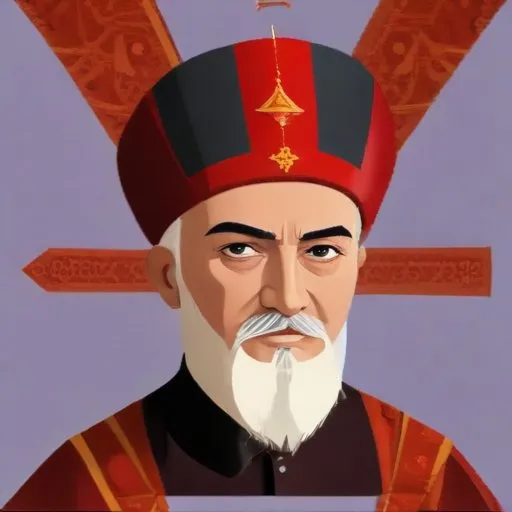
A 16th-century Kurdish emir who wrote a renowned history of the Ottoman Empire, providing valuable insights into the region's politics and culture. His book remains a significant historical source to this day.
Sharaf Khan Bidlisi is renowned for his magnum opus, the Sharafnama, a sprawling historical epic that chronicles the medieval history of the Kurdish people. This seminal work, penned in the 16th century, cements Bidlisi's status as a towering figure in the realm of Middle Eastern historiography.
Bidlisi was born in 1543 in the ancient city of Bidlis, nestled in the heart of Kurdistan. His early years were marked by an insatiable thirst for knowledge, which drove him to pursue advanced studies in theology, literature, and philosophy. His intellectual prowess soon caught the attention of the Ottoman Empire, and he was appointed as a diplomat and advisor to the imperial court.
Bidlisi's writings are steeped in a profound understanding of Sufism, a mystical tradition within Islam that emphasizes the inner dimension of faith. His poetry, in particular, is suffused with Sufi themes, as he explores the mysteries of the human condition and the nature of the divine. His philosophical contributions are a testament to the rich cultural heritage of the Middle East, where faith and reason converged in a dynamic synthesis.
The Sharafnama, Bidlisi's crowning achievement, is a meticulously researched and eloquently written account of the Kurdish people's struggles and triumphs. This sweeping narrative spans several centuries, shedding light on the intricate web of alliances and rivalries that shaped the region's complex history. Bidlisi's commitment to historical accuracy and his critical approach to sources have made the Sharafnama an indispensable resource for scholars and historians.
Bidlisi's work has had a profound impact on modern Kurdish identity and cultural heritage. The Sharafnama has inspired generations of scholars, writers, and artists, shaping the way Kurds understand their history and their place within the region. Moreover, Bidlisi's diplomatic career has served as a model for statesmanship and international cooperation, offering valuable lessons for contemporary leaders and policymakers.
Bidlisi's life and works are situated at the confluence of two great empires: the Ottoman and the Safavid. His experiences as a diplomat and historian provide a unique window into the intricate dynamics of power and culture that shaped the early modern Middle East. As a Kurd, Bidlisi's legacy serves as a testament to the rich cultural heritage of the region, where diverse traditions and identities intersect and overlap.
Bidlisi's historical magnum opus, the Sharafnama, is often compared to the works of other prominent historians of the era, such as Mustafa Ali and Ibrahim Pecevi. While these contemporaries focused on the Ottoman Empire's grand narrative, Bidlisi's work stands out for its nuanced attention to the experiences of the Kurdish people, offering a vital corrective to the dominant historiographical narratives of the time.
Born in 1494
Ruling the Ottoman Empire at its peak, he expanded its borders, conquered Belgrade, and laid siege to Vienna, earning a reputation as a brilliant military strategist and statesman. He also codified laws and reformed the empire's administration.
