


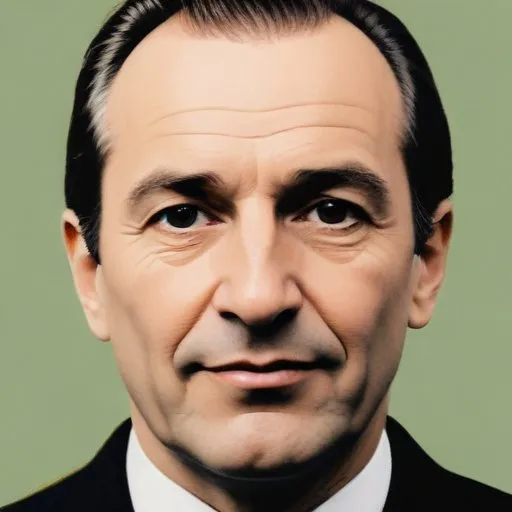
A German artist who blended photography and painting to create witty, irreverent works that critiqued consumer culture and challenged artistic norms. Known for his playful, subversive style that blurred the lines between high and low art.
Sigmar Polke, the renowned German painter and photographer, is best known for his provocative and eclectic style, which defied conventions and challenged the status quo of modern art. Through his pioneering work, he injected a sense of humor, irony, and social commentary into the art world, earning him the reputation as one of the most innovative artists of the 20th century.
Born on February 13, 1941, in Oels, Lower Silesia, Polke's early life was marked by tumult and upheaval. Following the expulsion of Germans after World War II, his family fled to Thuringia in 1945, and later escaped from the Communist regime in East Germany in 1953, settling in West Germany. This nomadic existence would later influence his artistic perspective, as he drew inspiration from the complexities of German history and identity.
In 1963, Polke, along with Gerhard Richter and Konrad Fischer, founded the movement known as Kapitalistischer Realismus (Capitalist Realism). This radical concept rejected the idealism of Abstract Expressionism, instead embracing the harsh realities of consumer culture and the banality of everyday life. Through their work, they critiqued the rapid modernization of post-war Germany, satirizing the excesses of capitalism and the commodification of art.
In the 1970s, Polke turned his attention to photography, exploring the medium's potential for social commentary and critique. His use of found images, collage, and appropriation techniques anticipated the conceptual art movement, blurring the lines between high and low culture. This period marked a significant shift in Polke's oeuvre, as he began to engage with the complexities of historical representation and the role of the artist as a mediator of cultural narratives.
In the 1980s, Polke returned to painting, but with a twist. He began experimenting with chance operations, allowing chemical reactions between paint and other substances to create unexpected patterns and textures. This process-oriented approach yielded works that were at once abstract, expressionist, and profoundly aleatoric. By relinquishing control, Polke tapped into the unpredictable nature of artistic creation, producing pieces that were both visually stunning and intellectually provocative.
In the final two decades of his life, Polke turned his attention to the weighty subject of historical events and their perceptions. His paintings from this period, characterized by vivid colors and intricate layering, probed the complexities of German history, from the Nazi era to the Cold War. Through his work, Polke sought to unsettle the complacent narratives of the past, revealing the intricate web of power, ideology, and memory that underpins human experience.
Awards and accolades punctuated Polke's career, including the Golden Lion at the 1986 Venice Biennale and the 1994 Praemium Imperiale. His influence extends far beyond his own oeuvre, as he inspired generations of artists, from the Young British Artists to the German Neo-Expressionists. Today, Polke's work is held in the collections of major museums worldwide, a testament to his enduring impact on the trajectory of modern art.
Polke's personal life was marked by a sense of camaraderie and artistic community. He was a professor at the Academy of Fine Arts, Hamburg, from 1977 to 1991, and later settled in Cologne, where he continued to work until his passing in 2010. His relationships with fellow artists, including Joseph Beuys and Georg Herold, were forged through shared artistic ideals and a passion for creative experimentation.
"Art is the only way to run away without leaving home."
"I'm not interested in making art that's just about art. I want to make art that's about the world."
Through his art, Polke left an indelible mark on the world, challenging our perceptions and understanding of the complexities of human experience. As we gaze upon his works, we are reminded of the power of art to provoke, to disturb, and to inspire.
94 Years Old
A pioneering artist who blurred the lines between photography and painting, creating bold, abstract works that challenged traditional notions of representation. Known for his bold, colorful, and often provocative pieces that explored the relationship between image and reality.
Born in 1921
A German artist who expanded the definition of sculpture by incorporating performance, installation, and activism, creating thought-provoking works that challenged social and political norms.
81 Years Old
A German artist renowned for his large-scale, emotionally charged paintings and sculptures that explore the intersection of history, mythology, and personal experience. His works often incorporate unconventional materials like straw, lead, and concrete.
88 Years Old
A pioneering figure in contemporary art, known for inverting and reconfiguring traditional representations of the human figure, often using bold, expressive brushstrokes and vibrant colors.
98 Years Old
A pioneer of kinetic art, creating immersive environments and sculptures that explore the relationship between light, space, and movement. Known for his innovative use of materials and technology to create interactive and dynamic art pieces.
