


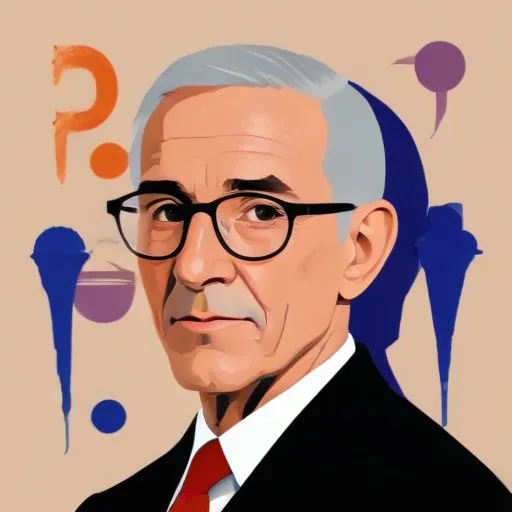
Pioneering biologist and complexity theorist who introduced the concept of autocatalytic sets, proposing that life emerged from self-organizing chemical reactions. His work bridges biology, physics, and philosophy.
Stuart Kauffman, a renowned American medical doctor, theoretical biologist, and complex systems researcher, is best known for his groundbreaking work on the origin of life on Earth. He challenges the conventional wisdom of Darwinian natural selection, proposing that the complexity of biological systems and organisms might result from self-organization and far-from-equilibrium dynamics.
Born on September 28, 1939, Stuart Kauffman graduated from Dartmouth in 1960. He then pursued a BA Hons at Oxford University, where he was a Marshall Scholar in 1963. Kauffman earned his medical degree (M.D.) from the University of California, San Francisco in 1968.
Kauffman's research has focused on the intersection of biology, physics, and mathematics. He is recognized for his contributions to the field of complexity biology, including:
His book, Origins of Order (1993), is a seminal work that explores the complexity of biological systems and the role of self-organization in their development.
Kauffman has received numerous awards for his contributions to science, including:
Kauffman's work has significant implications for our understanding of the natural world and the role of complexity in biological systems. He challenges the traditional view of evolution, arguing that self-organization and far-from-equilibrium dynamics play a crucial role in the emergence of complex life forms.
Kauffman's ideas have sparked debate and discussion in the scientific community, encouraging a reevaluation of the fundamental principles of biology and the nature of life itself.
Kauffman's work has far-reaching implications for fields beyond biology, including:
His ideas have inspired new approaches to understanding and addressing complex problems in fields such as medicine, ecology, and economics.
Stuart Kauffman's pioneering work has left an indelible mark on the scientific community. His contributions continue to inspire and challenge researchers, encouraging a deeper understanding of the intricate complexities of life and the natural world.
As a leading figure in the field of complexity biology, Kauffman's legacy extends beyond his own research, influencing the way we think about and approach complex problems in a wide range of disciplines.
Born in 1916
Pioneering scientist who discovered the structure of DNA, revolutionizing our understanding of genetics and life itself.
98 Years Old
Discovered the structure of DNA, revolutionizing our understanding of genetics and earning a Nobel Prize. Pioneering work in molecular biology has far-reaching implications for medicine and beyond.
85 Years Old
A renowned evolutionary biologist and science writer, known for popularizing science and advocating for atheism through bestselling books like "The Selfish Gene" and "The God Delusion".
85 Years Old
A renowned paleontologist, biologist, and author who challenged traditional views on evolution and natural history through engaging writings and groundbreaking research.
97 Years Old
A renowned biologist and author who has made groundbreaking contributions to our understanding of ecology, evolution, and conservation, and is known for his advocacy for biodiversity and the preservation of natural habitats.
88 Years Old
Pioneering biologist who challenged conventional views on evolution, proposing that symbiotic relationships between organisms drove the development of complex life forms. Her work revolutionized our understanding of cellular biology and the natural world.
91 Years Old
A renowned space expert who explored the universe, searching for life beyond Earth and explaining complex science in simple terms.
Born in 1920
A British scientist who contributed significantly to the discovery of the structure of DNA, providing high-quality X-ray crystallography images that helped James Watson and Francis Crick develop their famous model.
