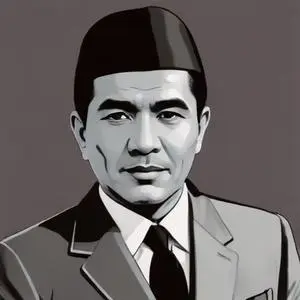
Sukarno: The Father of Indonesian Independence
A Life Dedicated to Freedom and Nationalism
Sukarno, Indonesia's first president, is best known for leading the country to independence from Dutch colonial rule and becoming a symbol of national pride. From 1945 to 1967, Sukarno served as the president, guiding Indonesia through its tumultuous early years and shaping the nation's identity.
The Early Years of a Nationalist
Born Koesno Sosrodihardjo on June 6, 1901, Sukarno was raised in a family of modest means in Blitar, East Java. His early life was marked by a strong sense of nationalism, which was fueled by his father's stories of Indonesia's rich cultural heritage and the injustices of colonial rule. Sukarno's passion for independence led him to become involved in the nationalist movement at a young age, and by the 1920s, he was already an influential figure in the Indonesian struggle for freedom.
The Road to Independence
Sukarno's leadership in the nationalist movement earned him a decade-long imprisonment by the Dutch colonial authorities. However, during World War II, Japanese forces invaded Indonesia, and Sukarno was released from prison. He saw an opportunity to collaborate with the Japanese to spread nationalist ideas and garner support for the Indonesian people. On August 17, 1945, Sukarno and
Mohammad Hatta declared Indonesian independence, and Sukarno was appointed president.
Leading the Resistance and Guided Democracy
Sukarno played a crucial role in leading the Indonesian resistance against Dutch attempts to reassert control over the country. Through diplomatic and military means, he ensured that Indonesia remained independent, earning him the title "Father of Proclamation." In 1959, Sukarno introduced Guided Democracy, an autocratic system that successfully ended the instability and rebellions that had been threatening the country's survival.
Anti-Imperialism and the Non-Aligned Movement
In the early 1960s, Sukarno embarked on a series of aggressive foreign policies, championing the Non-Aligned Movement and personally spearheading the anti-imperialist efforts. This led to increased friction with the West and closer relations with the USSR. Sukarno's foreign policy was marked by his commitment to preserving Indonesia's sovereignty and promoting international cooperation.
Legacy and Controversy
Sukarno's later years were marked by controversy, and in 1965, the 30 September Movement led to a military overthrow of his government. Sukarno was replaced by General Suharto, who went on to rule Indonesia for over three decades. Sukarno's legacy is complex, with some viewing him as a hero and others criticizing his authoritarian rule and human rights abuses.
Personal Milestones and Key Life Events
- 1901: Born Koesno Sosrodihardjo in Blitar, East Java
- 1920s: Became involved in the Indonesian nationalist movement
- 1930s: Imprisoned by the Dutch colonial authorities for over a decade
- 1942: Released from prison by Japanese forces during World War II
- 1945: Declared Indonesian independence and appointed president
- 1959: Introduced Guided Democracy
- 1965: Overthrown by General Suharto's military coup
- 1970: Died on June 21, aged 69
Quotes and Memorable Sayings
"Give me 10 years, and I'll change the face of Indonesia. Give me 100 years, and I'll change the face of the world."
"Indonesia's independence is not just a matter of changing the ruler, but a total transformation of the society."
Sukarno's life was a testament to his unwavering commitment to Indonesia's independence and his people. Despite the controversies surrounding his rule, Sukarno remains an important figure in Indonesian history, and his legacy continues to inspire and influence the nation to this day.
FAQ
What was Sukarnos role in Indonesian history?
Sukarno was the 1st President of Indonesia, serving from 1945 to 1967. He played a crucial role in leading Indonesias struggle for independence from the Netherlands and was instrumental in shaping the countrys early years.
What is Sukarnos legacy in modern Indonesia?
Sukarnos legacy in modern Indonesia is complex. He is remembered as a national hero who fought for independence, but his authoritarian rule and later association with communism have also been criticized.
What was Sukarnos relationship like with the Netherlands?
Sukarno was a key figure in the Indonesian struggle for independence from the Netherlands. He led the countrys resistance against Dutch colonial rule and eventually declared Indonesias independence in 1945.
What was Sukarnos role in the Non-Aligned Movement?
Sukarno was a key figure in the Non-Aligned Movement, a group of countries that sought to remain neutral during the Cold War. He hosted the 1955 Asian-African Conference in Bandung, which led to the establishment of the movement.
When did Sukarno pass away?
Sukarno passed away on June 21, 1970, at the age of 69, leaving behind a complex legacy in Indonesian history.