


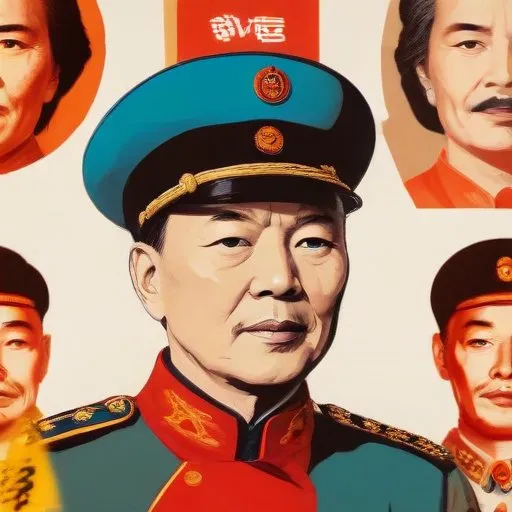
A prominent military leader and politician who played a key role in China's Republican era, known for his efforts to modernize the Chinese army and resist Japanese invasion.
Sun Lijen, a renowned Chinese Nationalist general, is revered for his exceptional leadership during the Second Sino-Japanese War and the Chinese Civil War. His impressive military achievements earned him the laudatory nickname "Rommel of the East," a testament to his tactical prowess and bravery on the battlefield.
Born on December 8, 1900, in Jinnu, Lujiang, Chaohu, Anhui, Sun Lijen's early life was marked by a sense of patriotism and adventure. He participated in the May Fourth Movement, marching at Tiananmen Square alongside other passionate students. In 1919, he married Gong Xitao and was admitted to Tsinghua University to study civil engineering.
During his time at Tsinghua, Sun Lijen discovered his passion for basketball, becoming a star player and leading the Chinese team to a gold medal at the 1921 Far Eastern Championship Games. With a Boxer Indemnity Scholarship, he transferred to Purdue University in the United States, graduating in 1924. A brief internship at Chicago Bridge & Iron Company in Chicago, Illinois, further honed his engineering skills.
Sun Lijen's military career was nothing short of remarkable. His New First Army, known as the "Best Army under heaven," effectively confronted Japanese troops in the 1937 Battle of Shanghai and the Burma Campaign from 1943 to 1944. His military strategies and leadership earned him accolades and recognition, cementing his reputation as a brilliant commander.
Sun Lijen's foreign military training and exposures influenced his approach to warfare, but he also adhered to traditional Chinese values and principles. He believed in the importance of discipline, loyalty, and camaraderie among soldiers, which he instilled in his troops to achieve victories against all odds.
Sun Lijen's contributions to Chinese history are undeniable. His military prowess and leadership during tumultuous times inspired generations of Chinese soldiers and civilians alike. His nickname "Rommel of the East" symbolizes his stature as a respected and feared military strategist, earning him a permanent place in the annals of Chinese history.
Sun Lijen's personal relationships and anecdotes offer a glimpse into his character. His marriage to Gong Xitao in 1919 was a testament to his commitment to family and loyalty. His Basketball achievements and engineering background highlight his multifaceted personality, revealing a man of diverse talents and passions.
In the face of adversity, Sun Lijen remained steadfast, demonstrating unwavering dedication to his country and his principles. His remarkable life serves as an inspiration to those seeking to make a positive impact in their own communities and nations.
Born in 1887
Led the Nationalist Party in China, fighting against the Communist Party and later establishing the government of Taiwan. He's known for his role in shaping modern Chinese history.
Born in 1897
Vice President of the Republic of China from 1954 to 1965, known for his role in Taiwan's government and diplomatic efforts during the Cold War era.
