


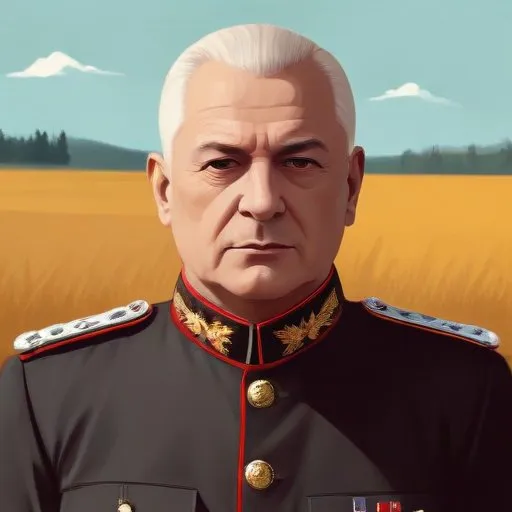
A Croatian-Austrian field marshal who played a crucial role in the Austro-Hungarian Army during World War I, leading troops to several victories and earning recognition for his military prowess. He's also known for his efforts to modernize the army and implement new tactics.
Svetozar Boroevi von Bojna, an Austro-Hungarian field marshal of Croatian Serb descent, is remembered as one of the most skilled defensive strategists of World War I. His unwavering determination and military prowess earned him the esteemed title of "Lion of Isonzo," a testament to his unrelenting spirit and tactical genius.
Boroevi was born on December 13, 1856, in the village of Umeti, Croatian Military Frontier. Baptized in the Eastern Orthodox Church, he would later become an ethnic Croat and proudly declare Croatia as his homeland.
At the tender age of ten, Boroevi joined cadet school, demonstrating his early dedication to a life of military service. He advanced swiftly through the ranks, becoming a corporal in 1872 and a lieutenant in 1875. His bravery and skill were recognized during battles in Bosnia in 1878, where he was awarded for his service in the capture of Sarajevo.
Before the outbreak of World War I, Boroevi commanded the 42nd Home Guard Infantry Division of the Croatian Home Guard. In 1903, he was formally released from the Home Guard, having already been assigned to the Imperial Royal Army in 1898.
Boroevi's military prowess reached new heights during World War I, where he commanded Austro-Hungarian forces in the Isonzo front. His unyielding defensive strategies earned him the respect and admiration of his comrades, as well as the enemy. His unwavering resolve and tactical brilliance secured key victories, cementing his reputation as the "Lion of Isonzo."
For his exceptional service during the war, Boroevi rose through the ranks, eventually becoming the first and only Austro-Hungarian field marshal of South Slavic descent.
Boroevi's military philosophy was rooted in his unwavering commitment to defense and strategy. He believed that a strong defense was the foundation of a successful military campaign, and his unrelenting dedication to this principle earned him the respect of his peers and the fear of his enemies.
Boroevi's legacy extends far beyond his military achievements. He remains an icon of Croatian and Serb heritage, a symbol of determination and resilience in the face of adversity. His military strategies and philosophies continue to inspire and influence modern military leaders, ensuring his place in the annals of history.
In conclusion, Svetozar Boroevi von Bojna's remarkable life serves as a testament to the power of determination, skill, and strategic thinking. As the "Lion of Isonzo," he etched his name in the hearts of nations, leaving behind a legacy that will continue to inspire generations to come.
Born in 1852
Austrian-Hungarian field marshal who served as Chief of the General Staff during World War I, playing a key role in the war's outbreak and course. He's known for his hawkish stance and aggressive military strategies.
Born in 1857
Austro-Hungarian general who played a key role in the Austro-Prussian War and later became a prominent military strategist, known for his innovative tactics and modernization of the Austro-Hungarian army.
Born in 1853
Austro-Hungarian Army officer who served as Governor of Bosnia and Herzegovina, infamous for his role in the events leading up to the assassination of Archduke Franz Ferdinand.
