


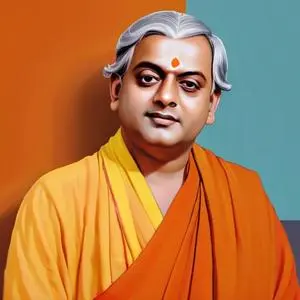
A key figure in introducing Indian philosophies to the Western world, he's known for his inspiring lectures and writings on spirituality, self-realization, and the unity of all religions.
Swami Vivekananda, born Narendranath Datta, is renowned for introducing Vedanta and Yoga to the Western world, and is credited with raising interfaith awareness and bringing Hinduism to the status of a major world religion in the late 19th century. As the chief disciple of the Indian mystic Ramakrishna, Vivekananda's teachings and ideologies continue to inspire millions globally.
Vivekananda was born on January 12, 1863, into an aristocratic Bengali Kayastha family in Calcutta. From a young age, he was drawn towards spirituality and religion, which eventually led him to find his guru, Ramakrishna. After Ramakrishna's death, Vivekananda became a monk and embarked on an extensive tour of the Indian subcontinent as a wandering monk, acquiring firsthand knowledge of the living conditions of Indian people in then British India.
The turning point in Vivekananda's life came when he traveled to the United States and addressed the 1893 Parliament of Religions in Chicago. His iconic speech, beginning with the words "Sisters and brothers of America...", mesmerized the audience and introduced Hinduism to Americans. The speech earned him widespread recognition, with an American newspaper describing him as "an orator by divine right" and "undoubtedly the greatest figure at the Parliament."
After his success at the Parliament, Vivekananda delivered hundreds of lectures across the United States, England, and Europe, disseminating the core tenets of Hindu philosophy. He founded the Vedanta Society of New York and the Vedanta Society of San Francisco (now Vedanta Society of Northern California), which became the foundations for Vedanta Societies in the West. In India, he established the Ramakrishna Math, which provides spiritual training for monastics and householders, and the Ramakrishna Mission.
Vivekananda's teachings emphasized the importance of non-dualism, self-realization, and service to humanity. He believed in the potential of each individual to attain spiritual enlightenment and advocated for the importance of education, science, and reason in the pursuit of spiritual growth. His philosophy was deeply rooted in Vedanta, which he believed was the essence of Hinduism.
Vivekananda's impact on modern society is multifaceted. He was a key figure in the Indian independence movement, and his ideologies inspired many Indian nationalists, including Mahatma Gandhi. He also played a significant role in popularizing Yoga and Vedanta in the West, paving the way for future generations of spiritual seekers.
Vivekananda's legacy continues to inspire millions worldwide. His teachings have influenced countless individuals, including spiritual leaders, politicians, and artists. He will always be remembered as a champion of Indian nationalism, a beacon of spiritual guidance, and a pioneer in promoting interfaith understanding and harmony.
Born in 1861
A Bengali polymath who wrote extensively on love, nature, and humanity, creating a unique blend of Indian and Western literary styles, and was the first non-European to win the Nobel Prize in Literature.
Born in 1872
An Indian spiritual leader who developed a philosophy of integral yoga, aiming to unite spiritual growth with worldly life, and wrote extensively on spirituality, philosophy, and poetry.
Born in 1869
Indian freedom fighter, activist, and philosopher who led India to independence from British rule through non-violent civil disobedience, inspiring civil rights movements worldwide.
Born in 1853
A spiritual leader and wife of Ramakrishna, known for her teachings on spirituality, self-realization, and women's empowerment. Her wisdom and compassion inspired many, especially women, to seek spiritual growth.
Born in 1893
An Indian-American spiritual leader who introduced millions to meditation and Eastern thought through his writings and teachings, most notably the bestselling book "Autobiography of a Yogi".
95 Years Old
A spiritual leader and poet who promoted inner peace, self-discovery, and world harmony through meditation, writing, and athletic endeavors. He founded the Sri Chinmoy Centre, inspiring thousands globally.
