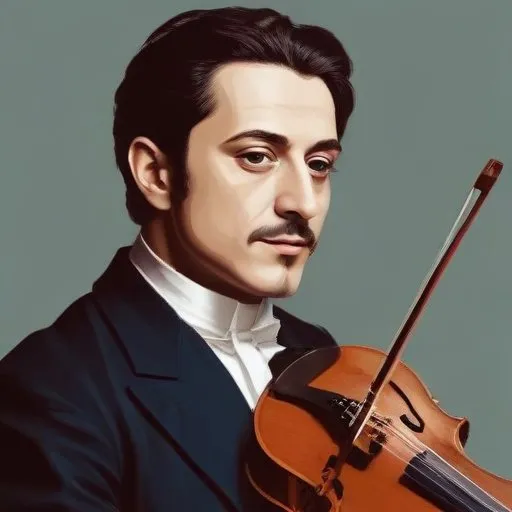
Sylvano Bussotti: The Renaissance Man of Italian Avant-Garde
A Master of Multitudes
Sylvano Bussotti, born on October 1, 1931, was an Italian composer of contemporary classical music, painter, set and costume designer, opera director, manager, writer, and academic teacher. He was renowned for his innovative compositions that employed graphic notation, which often created unique problems of interpretation.
A Child Prodigy and Early Beginnings
At the tender age of five, Bussotti started learning the violin under the guidance of Margherita Castellani, quickly becoming a prodigy. His uncle, Tono Zancanaro, and brother, Renzo, introduced him to the world of painting. This early exposure to the arts set the foundation for his multifaceted career.
Formative Years and Influences
Bussotti studied harmony and counterpoint at the Florence Conservatory with Roberto Lupi and piano with Luigi Dallapiccola. However, due to World War II, he did not receive a diploma. Undeterred, he continued to study composition on his own. In 1956, he went to Paris, where he studied privately with Max Deutsch and met influential figures such as Luigi Nono,
Pierre Boulez, and Heinz-Klaus Metzger. This exposure led to him being introduced to the Darmstadt Ferienkurse, a significant platform for avant-garde music.
Early Works and Successes
Bussotti's first publically performed composition, "Breve," was played by Françoise Deslogres at a Düsseldorf gallery in 1958, with
John Cage in the audience. Cathy Berberian, a renowned soprano, sang his works, conducted by Boulez. In the 1960s, he traveled to the United States, visiting Buffalo and New York, where he was invited by the Rockefeller Foundation.
Operatic Masterpieces and Stage Works
Bussotti's first opera, "La Passion selon Sade," premiered in Palermo in 1965. He went on to create numerous operas and ballets that premiered at esteemed institutions such as the Teatro Comunale di Firenze, Teatro Lirico di Milano, Teatro Regio di Torino, and Piccola Scala di Milano. His compositions for the stage showcased his innovative spirit and mastery of graphic notation.
Teaching and Leadership Roles
Bussotti was an influential teacher, sharing his knowledge at institutions worldwide. He taught at the Fiesole School of Music for over a decade and was artistic director of La Fenice in Venice, the Puccini Festival, and the music section of the Venice Biennale.
Legacy and Impact
As a leading composer of Italy's avant-garde movement, Bussotti's contributions to the world of music and art are immeasurable. His unique blend of creative talents and innovative spirit continues to inspire generations of artists and musicians.
Quotes and Memorable Sayings
- "The score is a tool, not a fetish."
- "The composer must be an architect of the unknown."
Personal Milestones and Key Life Events
- 1964: Visited the United States, invited by the Rockefeller Foundation
- 1965: Premiered his first opera, "La Passion selon Sade," in Palermo
- 1972: Visited Berlin, invited by the German Academic Exchange Service (DAAD) for the Ford Foundation
Controversies and Public Perception
Bussotti's innovative approach to music and art often led to controversy and debate among critics and audiences. His use of graphic notation and unconventional compositional techniques sparked heated discussions about the role of the composer and the importance of traditional notation.
Awards and Honors
Throughout his illustrious career, Bussotti received numerous awards and honors for his contributions to music and art.
Visual Timeline and Milestones
| 1931 |
Born on October 1 in Florence, Italy |
| 1956 |
Studied privately with Max Deutsch in Paris |
| 1958 |
First public performance of "Breve" in Düsseldorf |
| 1964 |
Visited the United States, invited by the Rockefeller Foundation |
| 1965 |
Premiered his first opera, "La Passion selon Sade," in Palermo |
| 1972 |
Visited Berlin, invited by the German Academic Exchange Service (DAAD) for the Ford Foundation |
| 2021 |
Passed away on September 19 |
Bussotti's extraordinary life and career serve as a testament to his boundless creativity, innovative spirit, and dedication to the arts. He leaves behind a legacy that will continue to inspire and influence generations of artists, musicians, and art enthusiasts.
FAQ
What was Sylvano Bussottis contribution to contemporary classical music?
Sylvano Bussotti was an Italian composer and violinist, known for his innovative and avant-garde approach to classical music. He was a key figure in the development of contemporary classical music, pushing the boundaries of traditional forms and techniques.
What was Sylvano Bussottis early life and musical training?
Sylvano Bussotti was born on October 1, 1931, in Florence, Italy. He began his musical training at a young age, studying violin and composition at the Florence Conservatory and later at the Paris Conservatory.
What were Sylvano Bussottis notable compositions?
Sylvano Bussotti composed a wide range of works, including operas, symphonies, and chamber music. His notable compositions include La Passion selon Sade, Nixon in China, and Le Roi Lear.
What awards and recognition did Sylvano Bussotti receive?
Sylvano Bussotti received several awards and honors for his contributions to music, including the Prix de Rome and the Premio Abbiati.
What is Sylvano Bussottis legacy in contemporary classical music?
Sylvano Bussotti left a lasting impact on contemporary classical music, remembered for his bold experimentation, innovation, and commitment to pushing the boundaries of traditional forms and techniques.