


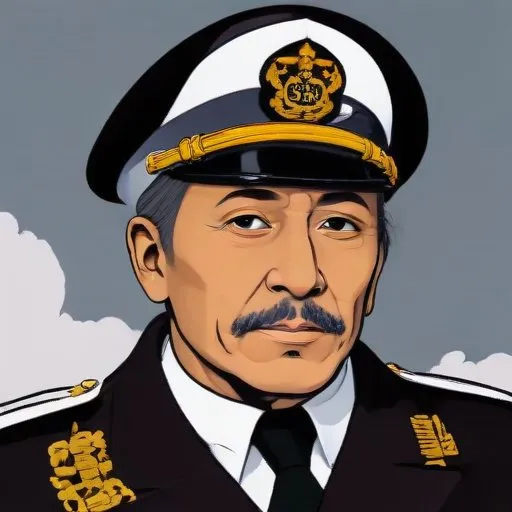
A pioneering Japanese naval aviator and admiral who played a crucial role in the development of Japan's naval aviation capabilities, leading the country's first successful aircraft carrier operation.
Takijir Nishi, a Japanese admiral, is infamously known as the mastermind behind the kamikaze, a desperate and deadly tactic employed by the Imperial Japanese Navy during World War II. Born on June 2, 1891, in Ashida village, Hyogo Prefecture, Nishi's fate was intertwined with the tumultuous era of Japanese history.
Nishi's remarkable career in the Imperial Japanese Navy Academy began in 1912, where he graduated 20th out of 144 cadets. His early assignments included serving on the cruiser Soya and battlecruiser Tsukuba, followed by a stint as a flight instructor at Kasumigaura.
As a sublieutenant, Nishi was dispatched to England and France in 1918 to study the development of combat aircraft and their use in World War I. Upon his return, he played a crucial role in shaping the Imperial Japanese Navy Air Service, serving in various staff positions related to naval aviation throughout the 1920s.
After being promoted to lieutenant commander, Nishi took command of the carrier air wing on the aircraft carrier Hōshō in 1928. He later became the executive officer of the aircraft carrier Kaga in 1932. His steady rise through the ranks culminated in his promotion to rear admiral in 1939, when he became the chief of staff of the 11th Air Fleet.
As the head of the Naval Aviation Development Division in the Ministry of Munitions, Nishi was instrumental in planning the attack on Pearl Harbor in 1941. Although he initially opposed the attack, citing concerns that it would lead to a full-scale war with the United States, his expertise was crucial in executing the operation.
As the war turned against Japan, Nishi's desperation led him to conceptualize the kamikaze, a tactic that would sacrifice thousands of young pilots in the name of national pride. This controversial decision cemented his place in history as the father of the kamikaze, a title that would haunt his legacy.
Takijir Nishi's life was marked by contradictions – his pursuit of innovation and his complicity in one of humanity's darkest hours. While his contributions to Japanese aviation were undeniable, his role in the kamikaze tactic forever tainted his reputation. Nishi's story serves as a poignant reminder of the devastating consequences of war and the complexities of human nature.
Takijir Nishi's life was a testament to the complexities of human nature, a tale of innovation, ambition, and the devastating consequences of war. His story continues to captivate and haunt us, serving as a poignant reminder of the importance of reflecting on our actions and their impact on humanity.
Born in 1884
Led the Imperial Japanese Navy during World War II, masterminding the surprise attack on Pearl Harbor, and later became a symbol of Japanese military power and strategy.
Born in 1902
Led the Japanese attack on Pearl Harbor, flying the lead plane and personally bombing the USS Arizona, a pivotal event in World War II.
Born in 1904
A pioneering Japanese aviator and strategist who masterminded the surprise attack on Pearl Harbor, revolutionizing naval warfare. He later became a prominent politician and advocate for international cooperation.
