


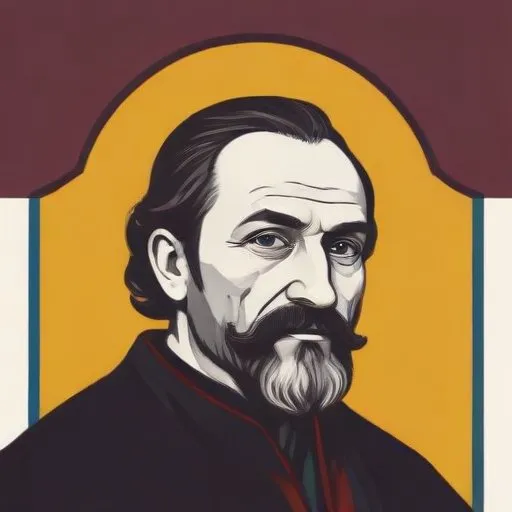
Ukraine's national poet and playwright, celebrated for his powerful writings that inspired a national awakening and struggle for independence, with works still widely read and performed today.
Known as the founding father of modern Ukrainian literature, Taras Shevchenko was a Ukrainian poet, writer, artist, and political figure who left an indelible mark on Ukrainian culture. His poetry collection, Kobzar, is regarded as the foundation of modern Ukrainian literature and has had a profound impact on the country's language and identity.
Born on March 9, 1814, in the village of Moryntsi, Kiev Governorate, Russian Empire, Shevchenko was the third child of Kateryna and Hryhoriy Ivanovych Shevchenko, former subjects of the Polish-Lithuanian Commonwealth who became serf peasants. Growing up in a family of modest means, Shevchenko's early life was marked by hardship and struggle, but it was also a time of great creativity and curiosity.
Shevchenko's early years were spent learning to read and write at a local school, where he was taught by the precentor of the village church, a harsh disciplinarian who believed in birching his students every Saturday. Despite the challenges, Shevchenko's love for learning and his natural talent for art and literature shone through, and he quickly became known for his remarkable skills as a painter and poet.
In 1838, Shevchenko's artistic talents caught the attention of Vasyl Hlazunov, a Russian artist who noticed him drawing while working as a serf. Hlazunov offered to purchase Shevchenko's freedom, and soon after, Shevchenko was enrolled in the Academy of Fine Arts in St. Petersburg. It was here that he began to develop his skills as a painter and writer, producing some of his most iconic works, including his poetry collection, Kobzar.
Kobzar, which means " bard" in Ukrainian, was published in 1840 and marked a turning point in Ukrainian literature. The collection of poetry and prose works was a powerful expression of Ukrainian identity and culture, and it quickly became a symbol of Ukrainian national pride. Today, Kobzar is regarded as a foundational text of Ukrainian literature, and its influence can be seen in the works of many Ukrainian writers and poets.
Shevchenko's work was deeply rooted in his commitment to Ukrainian nationalism and his desire to promote Ukrainian culture and language. He believed in the power of art and literature to inspire and educate, and he saw his work as a way to preserve Ukrainian traditions and customs.
Shevchenko's legacy extends far beyond his own lifetime. His work has inspired generations of Ukrainian writers, artists, and politicians, and he is widely regarded as a national hero in Ukraine. Today, his poetry and prose continue to be celebrated and studied around the world, and his influence can be seen in Ukrainian culture, politics, and society.
Taras Shevchenko's legacy is immeasurable. He is a symbol of Ukrainian national pride, and his work continues to inspire and educate people around the world. His poetry and prose have had a profound impact on Ukrainian literature and culture, and he is widely regarded as one of the most important figures in Ukrainian history.
In the words of Shevchenko himself, " Ukraine will arise, as the sun rises, and her enemies will perish, as the night perishes." Today, his words continue to inspire Ukrainians and non-Ukrainians alike, and his legacy will forever be etched in the annals of Ukrainian history.
Born in 1856
A Ukrainian literary icon, celebrated for his poetry and novels that explored themes of social justice, Ukrainian identity, and folk culture. His works are considered a cornerstone of Ukrainian literature.
