


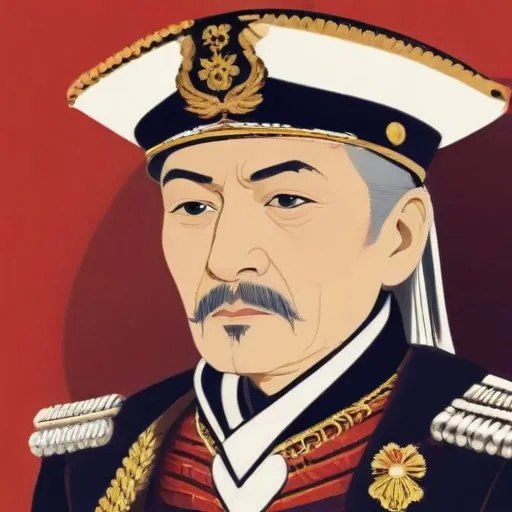
A Japanese admiral who led the Imperial Japanese Navy to several victories during the Russo-Japanese War, including the Battle of Tsushima, which cemented Japan's rise as a naval power. He's known for his innovative tactics and strategies that revolutionized naval warfare.
Tg Heihachir, a renowned admiral of the fleet, is celebrated as one of Japan's greatest naval heroes, earning the admiration of his contemporaries and subsequent generations alike. His remarkable achievements during the Russo-Japanese War of 1904-1905, particularly his decisive victory at the Battle of Tsushima, solidified his position as a national icon, with Western journalists aptly dubbing him "the Nelson of the East."
Born on January 27, 1848, in the Kajiyach district of Kagoshima, Satsuma domain (modern-day Kagoshima Prefecture), Tg was the third of four sons to Tg Kichizaemon, a samurai serving the Shimazu daimy, and Hori Masuko, a noblewoman from the same clan. As a youth, he was educated in the traditional samurai arts, with a focus on martial prowess and literary studies.
Tg's military career spanned over three decades, during which he played a pivotal role in shaping the Imperial Japanese Navy. He served as Commander-in-Chief of the Combined Fleet during the Russo-Japanese War, successfully confining the Russian Pacific naval forces to Port Arthur before achieving a crushing victory over a relieving fleet at the Battle of Tsushima in May 1905. This triumph was a testament to his exceptional strategic acumen and leadership, cementing his status as a national hero.
In recognition of his outstanding contributions, Tg was bestowed with numerous honors, including the highest rank of Gensui (Fleet Admiral) in the Imperial Japanese Navy. Shrines and streets have been named in his honor, a testament to the enduring reverence in which he is held. His legacy extends beyond Japan, with Western journalists and historians acknowledging his achievements as one of the most remarkable in naval history.
As a devout Buddhist, Tg's philosophical beliefs were deeply rooted in the principles of Bushido, the code of conduct followed by the samurai class. His strong sense of discipline, loyalty, and selflessness guided his actions throughout his life, earning him the respect and admiration of his peers and subordinates alike.
Tg's achievements must be viewed within the context of Japan's rapid modernization during the Meiji period, as the country sought to assert its presence on the global stage. His military prowess and strategic genius drew comparisons with legendary admirals such as Horatio Nelson, earning him a place among the pantheon of great naval heroes.
Tg Heihachir's remarkable life and achievements continue to inspire generations, serving as a testament to the power of dedication, discipline, and vision. As a national hero, his legacy remains an integral part of Japan's complex and fascinatinmilitary history, with his name etched in the annals of time as a shining example of excellence and achievement.
Born in 1884
Led the Imperial Japanese Navy during World War II, masterminding the surprise attack on Pearl Harbor, and later became a symbol of Japanese military power and strategy.
Born in 1902
Led the Japanese attack on Pearl Harbor, flying the lead plane and personally bombing the USS Arizona, a pivotal event in World War II.
Born in 1904
A pioneering Japanese aviator and strategist who masterminded the surprise attack on Pearl Harbor, revolutionizing naval warfare. He later became a prominent politician and advocate for international cooperation.
