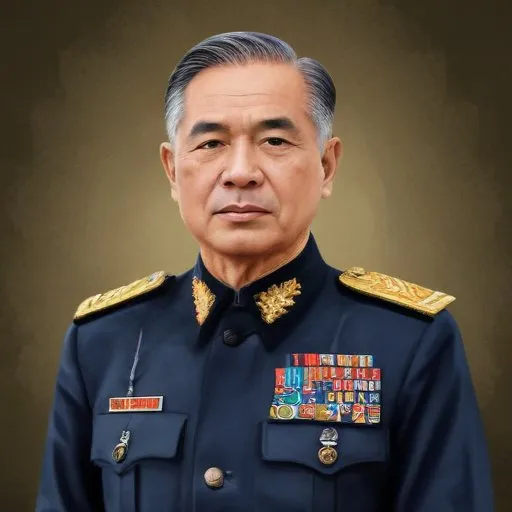
Thanom Kittikachorn: The Military Leader Who Shaped Thailand's Politics
A Life of Military Coups and Political Ambition
Thanom Kittikachorn is best known for his role as Thailand's prime minister from 1963 to 1973, a period marked by his own self-coup and ultimately, his forced resignation. This controversial figure's life was defined by his involvement in multiple military coups, which significantly impacted Thailand's political landscape.
Early Life and Rise to Power
Thanom was born on August 11, 1911, in Tak Province, Thailand, to a family of Thai Chinese descent. He attended Wat Koak Plu Municipal School and later joined the Army Cadet Academy. After receiving his commission, he served in the Infantry Regiment VII in Chiang Mai. Thanom's military career was marked by his participation in the 1947 coup, led by Colonel Sarit Thanarat, which propelled him to prominence.
- In 1951, Thanom was appointed a member of parliament, marking the beginning of his political career.
- He was promoted to major general in the same year and later became the commander of the 11th Infantry Division.
Consolidation of Power and the 1971 Coup
Thanom's political ambitions continued to grow as he held various positions, including deputy cooperatives minister in 1955. He represented Thailand at the ceremony marking the end of the Korean War in 1953 and later became the commander of the 1st Region Army. In 1963, he became the country's defence minister and eventually, the prime minister.
However, in 1971, Thanom staged a self-coup, dissolving the national assembly and the government. This move sparked widespread protests, which ultimately forced him to step down in 1973.
Exile and Return: A Recipe for Chaos
Thanom fled to Taiwan after his resignation but returned to Thailand in 1976. His return sparked violent protests, which led to a massacre of demonstrators and eventually, a military coup. This marked the end of Thanom's political career, and he spent the remainder of his life in relative obscurity.
Legacy of Controversy
Thanom Kittikachorn's legacy is marred by controversy and bloodshed. His involvement in multiple military coups and his own self-coup have left an indelible mark on Thailand's political history. His return from exile and the subsequent massacre of protesters cemented his reputation as a polarizing figure.
Despite the controversy surrounding his life, Thanom's impact on Thailand's politics and military cannot be denied. His rise to power and eventual downfall serve as a cautionary tale about the dangers of unchecked ambition and the importance of accountability in politics.
FAQ
What was Thanom Kittikachorns role in Thai politics?
Thanom Kittikachorn was a Thai field marshal and politician who served as the 10th Prime Minister of Thailand from 1963 to 1973.
What were Thanom Kittikachorns accomplishments as Prime Minister?
Thanom Kittikachorns accomplishments as Prime Minister include modernizing the Thai economy, improving infrastructure, and promoting national unity.
What was Thanom Kittikachorns stance on communist insurgency?
Thanom Kittikachorn took a hardline stance against communist insurgency, leading a military campaign against communist rebels in northern Thailand.
What was Thanom Kittikachorns role in the 1973 Thai student uprising?
Thanom Kittikachorns government was overthrown in the 1973 Thai student uprising, which demanded democratic reforms and an end to military rule.
What is Thanom Kittikachorns legacy in Thai politics?
Thanom Kittikachorns legacy in Thai politics is that of a strongman leader who ruled Thailand for over a decade, leaving a complex and contested legacy.