


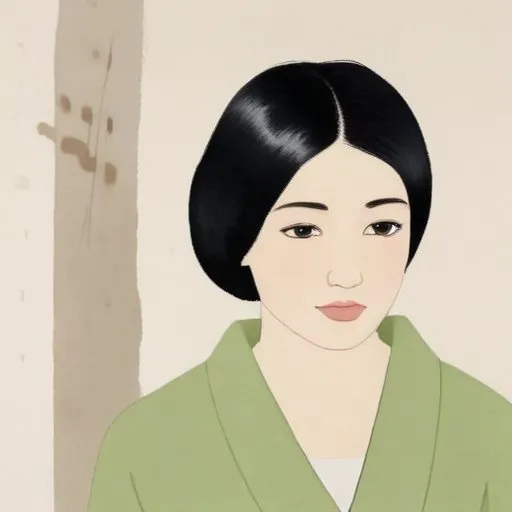
A Japanese-French artist celebrated for blending Eastern and Western styles, creating striking portraits and landscapes that captivated the art world with their unique fusion of techniques.
Tsuguharu Foujita, a Japanese-French painter, is renowned for his unique blend of traditional Japanese techniques and modern European styles, which captivated the art world in the 1920s. His stunning watercolor and oil paintings of nudes, still lifes, and self-portraits cemented his position as a celebrated figure in the Parisian art scene.
Foujita was born on November 27, 1886, in Ushigome, Tokyo, Japan. He studied Western-style painting at the Tokyo School of Fine Arts, where he was influenced by Japanese ukiyo-e woodblock prints and European Impressionism. In 1913, he traveled to Paris, immersing himself in the vibrant art scene of Montparnasse.
Foujita's eclectic style, which combined bold lines, vivid colors, and sensitive portraiture, quickly gained recognition in Paris. His fashion sense, characterized by a shaved head and thick-rimmed glasses, added to his enigmatic persona. Foujita's art was a commercial success, with his watercolors and oils selling rapidly to collectors and dealers.
During this period, Foujita befriended notable artists, including Amedeo Modigliani, Pablo Picasso, and Henri Matisse. Their influence can be seen in his work, which often featured nudes with elongated faces, a characteristic of Modigliani's style.
In 1931, Foujita embarked on a three-year journey through South and North America, documenting his experiences in sketches and paintings. This period allowed him to explore new themes and techniques, which would later influence his work.
Foujita returned to Japan in 1933, where he was appointed an official war artist during World War II. His oil paintings of battle scenes aimed to boost the morale of Japanese troops and citizens. Although his work was acclaimed during the war, it later became a source of controversy in the wake of Japan's defeat.
In 1950, Foujita returned to France, where he spent the remaining years of his life. He received French nationality in 1955 and converted to Catholicism in 1959. Foujita's latter years were devoted to creating frescoes for a small, Romanesque chapel in Reims, which he had built.
Foujita passed away on January 29, 1968, shortly after the chapel's official opening. His legacy as a celebrated artist was cemented in France, although opinions about his work remain divided in Japan.
Since 2006, retrospective exhibitions in Japan have sought to reevaluate Foujita's contribution to Japanese twentieth-century art history. His unique blend of Eastern and Western styles has inspired generations of artists, solidifying his position as a pioneering figure in modern art.
Born in 1881
A pioneering artist who transformed modern art with pioneering Cubist works, creating a new visual language that continues to inspire and influence art, design, and culture.
Born in 1869
A pioneering artist who revolutionized modern art with bold, expressive, and colorful works that blurred the lines between painting and sculpture, creating a new language of form and color.
Born in 1884
An Italian artist famous for elongated, emotive portraits and nudes that blended primitivism with cubism, capturing the essence of his subjects with expressive simplicity.
Born in 1904
A renowned surrealist master of bizarre, dream-like paintings and sculptures that blur reality and fantasy, known for iconic works like "The Persistence of Memory" and "The Elephants".
Born in 1898
A Belgian surrealist painter who challenged perceptions by depicting everyday objects in unexpected contexts, creating thought-provoking and witty visual paradoxes.
Born in 1891
A pioneering figure in Surrealism, creating dreamlike, fantastical works that blurred reality and the subconscious, influencing generations of artists.
Born in 1893
A renowned Spanish artist, famous for his vibrant, dreamlike paintings and sculptures that blended abstraction and surrealism, creating a unique visual language. His works often featured bold colors, biomorphic forms, and a sense of playfulness.
Born in 1907
A Mexican artist who created vibrant, emotional, and often unsettling paintings that explored her own experiences with physical and emotional pain, as well as her cultural heritage.
