


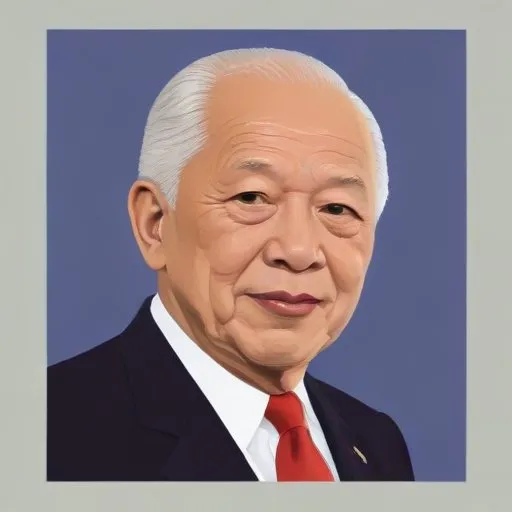
First Chief Executive of Hong Kong, overseeing the territory's transition from British to Chinese rule and shaping its early years of autonomy. He's known for his pro-Beijing stance and handling of the SARS outbreak.
Tung Cheehwa is renowned for being the first Chief Executive of Hong Kong, serving from 1997 to 2005, during the territory's transfer of sovereignty from Britain to China. He played a pivotal role in shaping the region's politics, economy, and infrastructure, leaving an indelible mark on Hong Kong's history.
Born on July 7, 1937, in Shanghai, China, Tung Cheehwa is the eldest son of the illustrious Tung Chao Yung, the founder of Orient Overseas Container Line (OOCL), a prominent shipping magnate. This lineage would ultimately shape his future endeavors and leadership style.
In 1981, following his father's passing, Tung took the reins of OOCL, navigating the company through turbulent times. By 1986, the business was on the brink of bankruptcy, but was salvaged through the intervention of the People's Republic of China government, courtesy of Henry Fok.
In 1992, Tung was appointed an unofficial member of the Executive Council of Hong Kong by the last British Governor, Chris Patten. This marked the beginning of his political career, with many speculating that he was Beijing's favored candidate to become the first Chief Executive of the Hong Kong Special Administrative Region (HKSAR).
In 1996, Tung was elected as the first Chief Executive of Hong Kong by a 400-member Selection Committee. During his tenure, he faced numerous challenges, including the 1997 Asian Financial Crisis and the bird flu outbreak. Despite these obstacles, he was re-elected unopposed in 2002.
However, his government was criticized for its handling of the proposed legislation of the Hong Kong Basic Law Article 23 and the SARS outbreak in 2003, prompting mass protests and calls for his resignation. Tung eventually stepped down on March 10, 2005, midway through his second term.
Following his resignation, Tung was appointed Vice Chairman of the Chinese People's Political Consultative Conference (CPPCC) by the Beijing government. In 2008, he founded the China-United States Exchange Foundation (CUSEF) to promote a positive image of China in the United States.
In 2014, Tung established the Our Hong Kong Foundation, a think tank comprising prominent business leaders, aimed at promoting Hong Kong's development and stability. He continues to wield significant influence in Hong Kong politics, earning him the moniker "kingmaker."
Tung Cheehwa's tenure as Chief Executive has had a lasting impact on Hong Kong's politics, economy, and society. While his leadership was not without controversy, he played a crucial role in shaping the region's transition from British rule to Chinese sovereignty.
Today, Tung remains an influential figure in Hong Kong, contributing to the region's development through his various initiatives and organizations. His legacy serves as a testament to his dedication to the people of Hong Kong and his commitment to promoting regional stability and prosperity.
99 Years Old
Former Chinese leader who ruled the country from 1989 to 2004, known for his economic reforms and authoritarian grip on power. He's also famous for his "Three Represents" theory, which aimed to broaden the Communist Party's appeal.
97 Years Old
A Chinese engineer-turned-politician who served as the 5th Premier of the People's Republic of China, known for his economic reforms and role in China's rapid growth. He's credited with transforming China into the world's second-largest economy.
83 Years Old
The 5th Paramount leader of China, who served from 2002 to 2012, is known for his role in China's rapid economic growth and his "Scientific Development Concept" policy. He also increased China's global influence through strategic diplomacy.
71 Years Old
The first Chief Executive of Hong Kong after its transfer of sovereignty from Britain to China, known for his controversial tenure marked by pro-democracy protests and struggles for universal suffrage.
81 Years Old
The 2nd Chief Executive of Hong Kong, a key figure in the region's governance and economy, known for navigating the territory's complex relationship with China. He's remembered for his efforts to balance Hong Kong's autonomy with Beijing's influence.
