


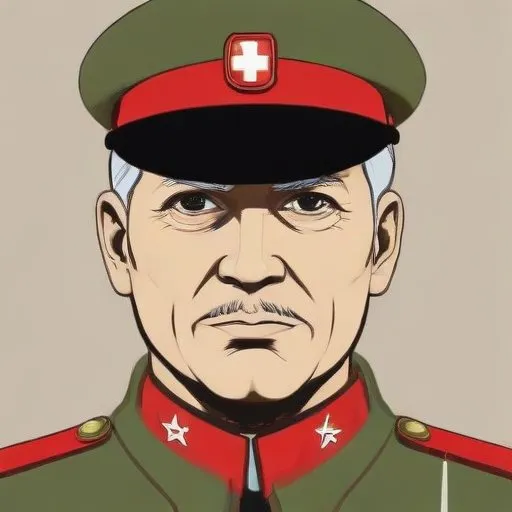
A Swiss army general who led the country's military forces during the French Revolutionary Wars and is credited with developing the country's modern military strategy. He's also known for his role in maintaining Switzerland's neutrality during the Napoleonic Wars.
Ulrich Wille, a name synonymous with military strategy and leadership, was the General of the Swiss Army during World War I, a position he held from 1914 to 1918. He is known for his attempts to modernize the Swiss Army, implementing Prussian techniques he had observed during his studies in Berlin, and his controversial views on neutrality during a time of great turmoil.
Conrad Ulrich Sigmund Wille was born on April 5, 1848, in Switzerland. He pursued his military education in Berlin, where he was exposed to Prussian military techniques that would later influence his leadership style.
Wille's military career was marked by rapid promotions, and by 1914, he had risen to the rank of Colonel. With the outbreak of World War I, he was nominated as the General of the Swiss Army by the Federal Parliament on August 8, 1914, with 122 votes in his favor.
Wille's military strategy was centered around the concept of "instruction, discipline, and technical control." He believed in modernizing the Swiss Army, and his leadership style was marked by a focus on pedagogy and discipline. During his tenure, he concentrated the bulk of his forces close to the borders, particularly in Ajoie and Engadine, in preparation for a potential attack.
Wille's leadership was not without controversy. He was known for his Germanophile views, which led to allegations of militarism and sparked political debates within Switzerland. In 1915, he proposed to the Federal Council that Switzerland enter the war on the side of the Central Powers, a move that was met with strong opposition. The "Colonels' Affair" in 1916, in which two Swiss colonels were found to have given German and Austro-Hungarian military secrets, further eroded public trust in Wille's leadership.
Wille's legacy is complex and multifaceted. While he is credited with modernizing the Swiss Army, his leadership was marked by controversy and political turmoil. Despite his flaws, he remains an important figure in Swiss military history, and his contributions to the development of the Swiss Army continue to be felt to this day.
Ulrich Wille's life and legacy serve as a reminder of the complexities of military leadership and the delicate balance between national interest and personal conviction. Despite his flaws, he remains an important figure in Swiss history, and his story continues to fascinate and educate us to this day.
Born in 1904
A Swiss physician and anesthesiologist who risked his life to save countless others during World War II, including prisoners of war and civilians, earning him the title "The Angel of Stalingrad".
