


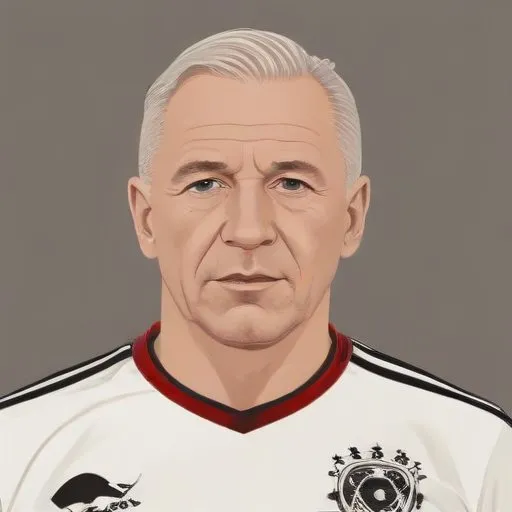
German football legend and captain of the national team, known for his exceptional goal-scoring skills and leadership on the pitch.
Uwe Seeler, widely regarded as one of the greatest players in German football history, is a name synonymous with goal-scoring prowess and leadership on the pitch. With an impressive portfolio of 137 goals in 239 Bundesliga games, 43 goals in 72 international games, and 21 goals in 29 European club tournament games, Seeler cemented his status as a legendary striker.
Born on November 5, 1936, in Hamburg, Germany, Seeler followed in his father's footsteps as a player for Hamburger SV, making his first-team debut in 1954 at just 17 years old. Despite receiving lucrative offers from Italian and Spanish clubs, Seeler remained loyal to Hamburg, where he worked towards building a second career as a merchant alongside his footballing endeavors.
Seeler's exceptional talent lay in his powerful and consistent striking ability, as well as his impressive aerial prowess. He was renowned for his overhead kicks, which often left opponents and spectators alike in awe. As captain of both Hamburger SV and the German national team, Seeler's leadership qualities shone through, earning him the respect of his teammates and opponents.
Seeler's trophy cabinet boasts an impressive array of accolades, including the German championship in 1960 and the DFB-Pokal in 1963. He was top scorer of the first Bundesliga season in 1963-64 and German Footballer of the Year in 1960, 1964, and 1970. His impressive performances also earned him a place among FIFA's 100 greatest living players in 2004.
In the 1960-61 season, Seeler, alongside his brother Dieter, helped lead Hamburger SV to the semifinals of the European Cup, where they narrowly missed out on the final against Benfica. Six years later, Seeler guided Hamburg to the final of the European Cup Winners' Cup, finishing as top scorer, only to lose out to AC Milan.
Seeler's contributions to German football were recognized with the Commanders Cross of the Order of Merit of the Federal Republic of Germany, making him the first footballer to receive this prestigious honor.
Uwe Seeler's enduring legacy in German football is a testament to his dedication, passion, and exceptional talent. As one of the country's greatest players, Seeler's influence on modern football is still felt today, inspiring generations of footballers to strive for greatness.
Seeler's remarkable career serves as a reminder of the importance of loyalty, hard work, and perseverance in achieving success. His inspiring story continues to captivate football enthusiasts worldwide, solidifying his place as a true legend of the beautiful game.
Did you know that Uwe Seeler scored four goals in his debut match for Hamburger SV at just 17 years old?
In conclusion, Uwe Seeler's outstanding achievements, leadership qualities, and unwavering dedication to the sport have earned him a permanent place in the annals of German football history.
70 Years Old
A German politician and businessman who served as the Minister of Food, Agriculture, and Consumer Protection from 2001 to 2005, known for his efforts to promote sustainable agriculture and animal welfare.
80 Years Old
A German football legend who won the World Cup as both a player and manager, known for his innovative style and leadership on the pitch.
70 Years Old
A German football legend who played for Bayern Munich and the national team, winning numerous titles, and later became a successful club executive.
74 Years Old
A legendary German midfielder who won the 1974 World Cup and is renowned for his attacking prowess and iconic hairstyle. He's a football legend and cultural icon of the 1970s.
82 Years Old
Legendary German goalkeeper and manager, known for his incredible reflexes and shot-stopping ability, earning him the nickname "Die Katze von Anzing" (The Cat from Anzing).
