


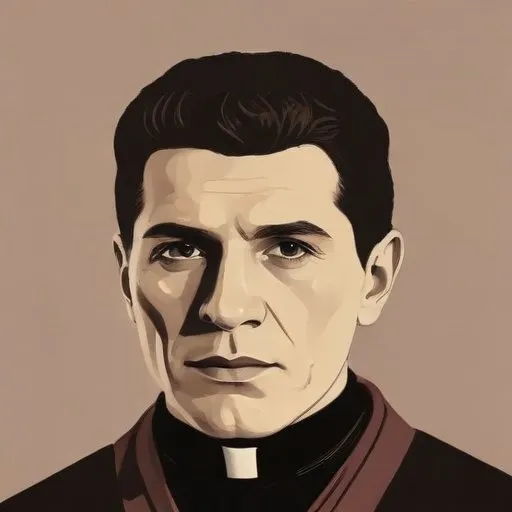
A Bulgarian Orthodox priest who turned revolutionary, fighting for independence from Ottoman rule and becoming a national hero, symbolizing freedom and patriotism.
Vasil Levski, also known as the "Apostle of Freedom," is a Bulgarian revolutionary who has become a national hero in his homeland. Born on July 18, 1837, Levski dedicated his life to liberating Bulgaria from Ottoman rule, and his legacy continues to inspire generations to this day.
Levski was born in Karlovo, a small town in the Sub-Balkan region of Bulgaria, to middle-class parents. He received a solid education, which laid the foundation for his future revolutionary ideas. At a young age, Levski became an Orthodox monk, but soon emigrated to Serbia to join the Bulgarian Legions, where he acquired the nickname "Lionlike."
Levski's experiences abroad helped shape his vision for a free and equal Bulgaria. He founded the Internal Revolutionary Organisation, which aimed to overthrow the Ottoman Empire through a network of secret regional committees. This innovative approach superseded the traditional foreign-based detachment strategy, and Levski's charismatic leadership earned him widespread support.
In Romania, Levski helped establish the Bulgarian Revolutionary Central Committee, comprising Bulgarian expatriates. This committee played a crucial role in coordinating the revolution, and Levski's tireless efforts ensured its success. During his tours of Bulgaria, Levski established a vast network of insurrectionary committees, preparing the ground for a nationwide uprising.
Levski's vision extended beyond mere liberation. He dreamed of a Bulgarian republic where ethnic and religious equality reigned, inspired by the liberal ideals of the French Revolution. In his own words, "We will be free in complete liberty, where the Bulgarian lives in Bulgaria, Thrace, Macedonia... people of whatever ethnicity live in this heaven of ours, they will be equal in rights to the Bulgarian in everything."
Ottoman authorities eventually caught up with Levski at an inn near Lovech, and he was executed by hanging in Sofia on February 18, 1873. This tragic event only strengthened Levski's legend, and his sacrifice continues to inspire Bulgarians to this day.
Vasil Levski's legacy is a testament to his unwavering dedication to his people. He is commemorated with monuments in Bulgaria and Serbia, and his name is synonymous with freedom, equality, and courage. Levski's story serves as a powerful reminder of the importance of standing up against oppression and fighting for one's rights.
Levski's philosophical contributions are rooted in his vision of a free and equal Bulgaria. He believed in the principles of liberty, equality, and fraternity, and his revolutionary movement aimed to create a society where all citizens, regardless of ethnicity or religion, enjoyed equal rights and opportunities.
Vasil Levski's legacy continues to inspire modern Bulgarians, and his ideas have had a lasting impact on the country's development. His emphasis on ethnic and religious equality has shaped Bulgaria's identity and informed its relationships with neighboring countries.
"We will be free in complete liberty, where the Bulgarian lives in Bulgaria, Thrace, Macedonia... people of whatever ethnicity live in this heaven of ours, they will be equal in rights to the Bulgarian in everything."
Vasil Levski's story is a powerful testament to the human spirit's capacity for courage, sacrifice, and vision. His legacy continues to inspire and motivate, serving as a beacon of hope for generations to come.
